

What is a guided Umrah service and how to choose one
Many Muslims wonder if performing Umrah on behalf of someone else is permitted, yet Islamic scholarship affirms its legitimacy. Guided Umrah services offer a structured, trustworthy way to fulfill this sacred duty for elderly or ill loved ones unable to travel. This article explains what these services are, their religious basis, documentation standards, humanitarian components, and practical steps to choose a reliable provider.
Table of Contents
- Introduction To Guided Umrah Services
- Religious Legitimacy And Islamic Rulings
- Documentation And Transparency In Guided Umrah
- Humanitarian And Social Impact
- Service Components And Logistics
- Common Misconceptions About Guided Umrah
- Comparison Of Guided Umrah Vs Traditional Umrah Packages
- Client Journey And Practical Steps
- Learn More And Book Your Guided Umrah Confidently
Key takeaways
| Point | Details |
|---|---|
| Definition | Guided Umrah services perform proxy pilgrimages with qualified agents and complete documentation for clients. |
| Religious validity | Scholarly consensus supports proxy Umrah when intention, qualified performance, and ritual compliance are met. |
| Documentation | Providers offer photo, video, and certificate proof to ensure spiritual peace of mind and service legitimacy. |
| Humanitarian impact | Many services donate a portion of profits to charitable causes, adding spiritual reward for clients. |
| Selection criteria | Choose providers based on religious compliance, transparent documentation, verified reviews, and clear booking terms. |
Introduction to guided Umrah services
Guided Umrah services are proxy pilgrimage programs where trained representatives perform the sacred rituals on behalf of individuals who cannot travel themselves. These services address a specific need within the Muslim community worldwide.
Families often seek these services when elderly parents, chronically ill relatives, or disabled loved ones wish to fulfill the spiritual blessing of Umrah but face insurmountable physical barriers. Guided Umrah services cater primarily to elderly and sick people unable to perform the pilgrimage themselves. The service model respects Islamic principles while providing practical solutions.
Typical clients include adult children arranging Umrah for aging parents, spouses seeking spiritual merit for bedridden partners, and caregivers fulfilling final wishes for terminally ill patients. They expect religious compliance, transparent proof of completion, and respectful handling of this sacred trust.
Key features that define guided Umrah services include:
- Qualified representatives who understand Umrah rituals thoroughly and perform them correctly
- Complete documentation through photos, videos, and personalized certificates
- Islamic compliance verified by scholars and fiqh authorities
- Transparent communication throughout the pilgrimage process
- Integration of humanitarian donations to maximize spiritual benefit
Understanding how guided Umrah services operate helps families make informed decisions when selecting a provider. These services bridge the gap between physical inability and spiritual aspiration, ensuring no Muslim is denied the blessings of Umrah due to circumstances beyond their control.
Religious legitimacy and Islamic rulings
The permissibility of performing Umrah on behalf of others has solid grounding in Islamic jurisprudence. Scholarly consensus across the four major Sunni schools affirms that proxy Umrah is valid when specific conditions are met.
The four pillars of Umrah must be rigorously fulfilled and documented to ensure religious compliance. These pillars include ihram (state of consecration), tawaf (circumambulation), sa’i (walking between Safa and Marwa), and halq or taqsir (hair cutting). Each step requires proper intention and execution.
Key conditions for valid proxy Umrah include:
- Clear intention (niyyah) stated before beginning the pilgrimage, specifying whom the Umrah is for
- The proxy performer must have already completed their own obligatory Umrah or Hajj
- All rituals must be performed in the correct sequence and manner
- The person on whose behalf Umrah is performed must be genuinely unable to travel
- Documentation should verify completion of each ritual step
Classical hadith literature supports this practice. The Prophet Muhammad (peace be upon him) permitted a woman to perform Hajj on behalf of her father who was too old to travel. This precedent extends to Umrah, which shares similar ritual structures.
“Performing Umrah on behalf of those unable to do so themselves is an act of devotion that carries immense spiritual reward for both the proxy and the beneficiary.”
Exploring Islamic rulings on proxy Umrah provides deeper insight into specific scenarios and conditions. Scholars emphasize that proxy Umrah legitimacy hinges on sincere intention and proper execution, not merely on financial transaction.
Contemporary scholarly fatwas on proxy Umrah continue to affirm this practice while providing guidance on modern implementation through organized services. Religious scholars recommend choosing providers who demonstrate knowledge of fiqh requirements and commit to full ritual compliance.
Documentation and transparency in guided Umrah
Documentation serves as the cornerstone of trust between guided Umrah providers and clients. Comprehensive proof of ritual completion addresses both spiritual assurance and practical verification needs.
Standard documentation packages typically include:
- Timestamped photographs showing the proxy performer at key ritual locations
- Video recordings of tawaf, sa’i, and other essential Umrah components
- Personalized certificates with client names, dates, and ritual completion confirmations
- GPS or location verification confirming the proxy’s presence in Makkah and Madinah
- Written reports detailing each step of the pilgrimage journey
This evidence provides families with tangible proof that their loved one’s spiritual obligation has been fulfilled correctly. The visual and documentary records offer peace of mind that cannot be achieved through verbal assurances alone.
Quality providers maintain high standards for documentation delivery. They provide materials within specified timeframes, organize files clearly by client name and date, and make documentation easily accessible through secure online portals or direct delivery.
Transparency extends beyond proof of completion. Reputable services clearly communicate their documentation policies before booking, specify what evidence clients will receive, and explain how long after the pilgrimage materials will be delivered.
Pro Tip: Before booking, request sample documentation from previous clients to evaluate the provider’s evidence quality and presentation standards.
Understanding documentation and booking transparency helps clients set appropriate expectations. Services offering full documentation and spiritual compliance demonstrate their commitment to both religious requirements and client satisfaction.
Documentation also serves religious purposes. It allows families to share proof with Islamic scholars if questions arise, provides records for personal spiritual archives, and creates lasting memories of this sacred act performed on behalf of loved ones.
Humanitarian and social impact
Many guided Umrah providers integrate charitable giving into their service model, amplifying the spiritual benefits for clients. This combination of worship and social responsibility reflects Islamic values of compassion and community support.
Some guided Umrah services donate 10% of their profits to humanitarian causes like Gaza relief. This approach allows clients to contribute to broader Muslim welfare while fulfilling individual religious obligations. The dual benefit enhances the spiritual reward associated with proxy Umrah.
Typical charitable allocations support:
- Emergency relief for Muslims facing conflict, natural disasters, or humanitarian crises
- Educational programs for underprivileged Muslim youth
- Healthcare services in underserved Muslim communities
- Food security initiatives addressing hunger and malnutrition
- Infrastructure projects like wells, schools, and medical clinics
Transparent providers clearly communicate their charitable commitments. They specify exact donation percentages, identify recipient organizations or causes, and sometimes provide impact reports showing how contributions have been used.
Client motivations for choosing providers with humanitarian components often extend beyond the proxy pilgrimage itself. Many families appreciate the opportunity to combine religious duty fulfillment with meaningful charitable impact, viewing it as a holistic expression of Islamic values.
“When your Umrah not only fulfills a loved one’s spiritual need but also feeds hungry children or provides medical care to the suffering, the blessings multiply exponentially.”
This integration addresses a growing demand among Muslims worldwide for services that reflect comprehensive Islamic ethics. It transforms a transactional service relationship into a partnership for broader community benefit and spiritual growth.
Providers who publicize their charitable work build trust and demonstrate genuine commitment to Islamic principles beyond profit maximization. This transparency in social responsibility has become a key differentiator in the guided Umrah service market.
Service components and logistics
Guided Umrah services manage complex logistical operations to ensure smooth proxy pilgrimage execution. Understanding these components helps clients appreciate the comprehensive nature of quality providers.

Visa processing represents the first critical step. Providers handle Saudi Arabia entry requirements, submit necessary documentation, and ensure legal compliance for their representatives. This eliminates bureaucratic obstacles that might otherwise delay or prevent Umrah performance.
Accommodation arrangements typically include:
- Hotels near the Grand Mosque in Makkah for convenient access to the Ka’bah
- Lodging in Madinah near the Prophet’s Mosque for those including Madinah visits
- Meal provisions and basic amenities to support the proxy performer’s needs
- Transportation between cities and to ritual sites
Dedicated guides accompany proxy performers to ensure proper ritual execution. These guides possess deep knowledge of Umrah requirements and help maintain focus on spiritual objectives throughout the journey. Their expertise prevents errors that could invalidate the pilgrimage.
Transportation logistics coordinate movement between airports, hotels, and holy sites. Reliable providers arrange comfortable, timely transport that respects the sacred nature of the journey while managing practical travel needs efficiently.
Some services include additional spiritual support such as dua (supplication) sessions, Quranic recitation on behalf of the beneficiary, or visits to other significant Islamic sites. These extras enhance the spiritual value beyond minimum Umrah requirements.
Exploring guided Umrah service package components reveals the depth of planning and coordination required. Quality providers orchestrate dozens of details seamlessly, allowing clients to focus on the spiritual significance rather than logistical concerns.
The step by step flow typically progresses from booking confirmation through visa processing, travel arrangements, ritual performance, documentation creation, and final delivery of proof to clients. Each phase requires careful management to maintain religious compliance and client satisfaction.
Common misconceptions about guided Umrah
Several widespread misunderstandings create unnecessary hesitation among Muslims considering proxy Umrah services. Addressing these misconceptions directly helps families make confident, informed decisions.
The most persistent misconception claims proxy Umrah lacks religious validity. This belief contradicts centuries of Islamic scholarship and established fiqh rulings. As previously discussed, all major schools of Islamic jurisprudence recognize the legitimacy of performing Umrah on behalf of others when proper conditions are met.
Some worry that proxy Umrah carries less spiritual weight than self-performed pilgrimage. While performing Umrah personally offers unique spiritual experiences, proxy Umrah performed with sincere intention on behalf of someone genuinely unable to travel holds full religious validity and brings immense reward.
Authenticity concerns arise when people question whether proxies genuinely perform the rituals. This skepticism highlights why comprehensive documentation is essential. Quality providers address this concern through extensive photo and video evidence, third party verification, and transparent communication.
Key misconceptions include:
- Belief that only self-performed Umrah counts spiritually
- Doubts about whether certificates and documentation are authentic
- Confusion over who receives the spiritual reward
- Assumptions that proxy services are a modern innovation lacking traditional support
- Concerns that distance invalidates the spiritual connection
Islamic jurisprudence clearly establishes that the beneficiary receives the spiritual reward when proxy Umrah is performed with correct intention. The proxy performer gains reward for their righteous action of helping others fulfill religious obligations.
Pro Tip: Consult with local Islamic scholars or imams if uncertainty persists, bringing documentation standards and provider credentials for their review.
Some people conflate guided Umrah services with travel agencies offering packages for personal pilgrimage. These are distinct services. Guided Umrah specifically addresses proxy performance with documentation, while traditional packages facilitate self-performed pilgrimage without proxy elements.
Understanding these distinctions and corrections helps families overcome hesitation rooted in misinformation. The practice has solid religious foundation, proven implementation, and widespread acceptance among contemporary Islamic scholars.
Comparison of guided Umrah vs traditional Umrah packages
Distinguishing between proxy guided Umrah services and conventional self-performed Umrah packages clarifies when each option is appropriate and what clients should expect from each.
| Feature | Guided Umrah Service | Traditional Umrah Package |
|---|---|---|
| Purpose | Proxy performance on behalf of someone unable to travel | Personal pilgrimage for the traveler themselves |
| Documentation | Extensive photo, video, and certificate proof for client | Standard travel photos, no formal religious documentation |
| Religious approval | Requires scholarly validation of proxy conditions | Direct personal fulfillment of religious obligation |
| Cost | Typically lower, covering proxy performer’s expenses only | Higher, covering client’s full travel and accommodation |
| Humanitarian component | Often includes charitable donations | Rarely includes systematic donation components |
| Client experience | Remote, based on trust and documentation | Direct personal spiritual experience |
Guided Umrah services focus on fulfilling religious duties for those facing insurmountable barriers. They emphasize proof of ritual completion, religious compliance verification, and often integrate charitable giving. The client never travels but receives comprehensive evidence that Umrah was performed correctly.
Traditional packages serve Muslims physically capable of traveling who wish to perform Umrah personally. These packages handle logistics like flights, hotels, and transport but leave the actual pilgrimage performance to the client. There is no proxy element or documentation requirement beyond standard travel records.
Pricing structures differ significantly. Guided Umrah costs reflect expenses for one proxy performer’s basic travel and accommodation needs. Traditional packages must cover full travel for clients, often including families, with varying comfort levels and extended stays.
Key differences in booking and execution:
- Guided services require clear identification of the beneficiary and specific intention statements
- Traditional packages focus on travel dates, accommodation preferences, and group sizes
- Guided services deliver documentation packages post-pilgrimage
- Traditional packages provide travel support during the journey itself
Spiritual assurance mechanisms also vary. Guided Umrah relies on documentation transparency and provider reputation. Traditional packages depend on the traveler’s own experience and personal spiritual connection during the pilgrimage.
Exploring the comparison of guided vs traditional Umrah packages helps clients select based on their specific circumstances. The right choice depends on whether the intended Umrah performer can physically travel and whether proxy performance is necessary.
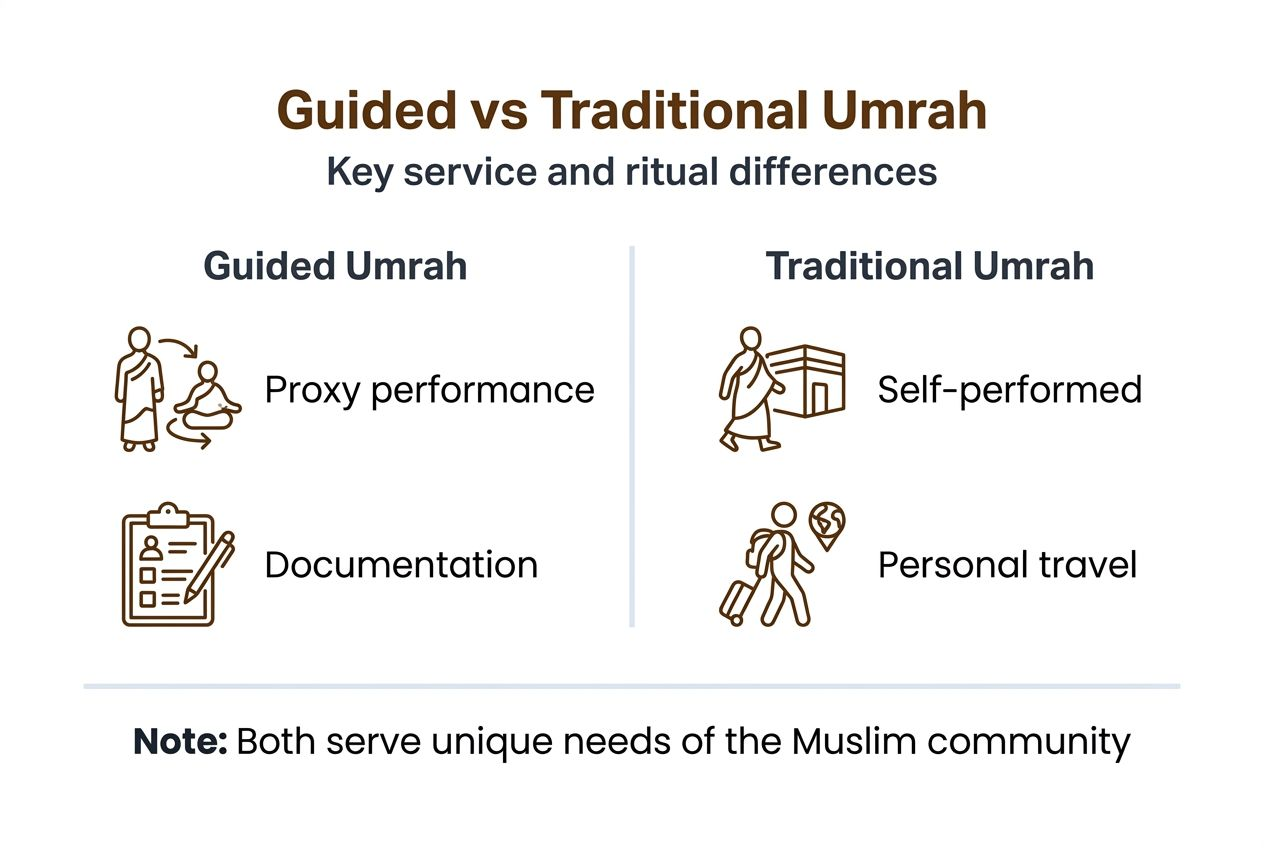
Neither option is inherently superior. They serve different needs within the Muslim community, both valid and valuable in their respective contexts.
Client journey and practical steps
Navigating the process of selecting and booking a guided Umrah service requires careful attention to key criteria and verification steps. This practical guidance helps ensure families choose providers who deliver on their spiritual and documentary promises.
The client journey typically unfolds in these stages:
- Clarify intention and confirm the beneficiary genuinely cannot perform Umrah personally due to age, health, or other valid reasons.
- Research multiple guided Umrah providers, comparing their religious credentials, documentation standards, and humanitarian commitments.
- Verify provider legitimacy through independent reviews, Islamic organization endorsements, and direct consultation with religious scholars if needed.
- Review terms carefully including what documentation will be provided, delivery timelines, refund policies, and charitable donation details.
- Complete booking by providing beneficiary information, intention statements, and any specific requests for additional spiritual services.
- Receive confirmation with expected completion dates and documentation delivery schedule.
- Monitor progress through provider updates during the pilgrimage period.
- Review delivered documentation thoroughly upon receipt, verifying all promised materials are included and meet quality expectations.
Key selection criteria include:
- Demonstrated knowledge of Islamic fiqh requirements for proxy Umrah
- Clear, comprehensive documentation policies with sample evidence available for review
- Transparent pricing with no hidden fees or ambiguous charges
- Responsive customer service addressing questions and concerns promptly
- Positive verified reviews from previous clients with similar needs
- Humanitarian or charitable components aligned with Islamic values
Pro Tip: Request detailed documentation timelines in writing and verify refund policies for scenarios where pilgrimage cannot be completed due to unforeseen circumstances.
Red flags that should prompt caution include vague answers about religious compliance, reluctance to provide sample documentation, absence of clear contact information, unrealistically low pricing that suggests corner cutting, or pressure tactics rushing booking decisions.
Communication throughout the process should be clear and respectful. Quality providers understand the sacred trust clients place in them and respond with patience, transparency, and detailed information.
Learning how to select a guided Umrah service empowers families to make confident decisions. The selection process requires diligence but ensures the profound spiritual obligation is fulfilled with integrity and proper Islamic compliance.
Learn more and book your guided Umrah confidently
Understanding guided Umrah services empowers you to fulfill sacred obligations for loved ones who cannot travel. Comprehensive resources help you explore every aspect of proxy pilgrimage with confidence.
Discover detailed guidance through our step-by-step guided Umrah process that walks you through booking to documentation delivery. Explore Islamic rulings on Badal Umrah from trusted scholars to strengthen your understanding of religious foundations. When ready, book trusted Umrah Badal packages that include complete documentation, humanitarian donations, and full religious compliance. These resources ensure you make informed decisions aligned with Islamic principles while securing spiritual peace of mind for your family.
Frequently asked questions
What is a guided Umrah service?
A guided Umrah service arranges for qualified representatives to perform the sacred pilgrimage rituals on behalf of individuals unable to travel due to age, illness, or disability. These services provide complete documentation including photos, videos, and certificates proving ritual completion according to Islamic requirements.
Who can benefit from proxy Umrah services?
Elderly parents who cannot withstand travel demands, chronically ill relatives facing mobility limitations, disabled individuals unable to perform physical ritual requirements, and those in end of life situations wishing to fulfill this spiritual obligation benefit most. Family members arrange these services as acts of devotion and care.
How do I verify a provider’s religious compliance?
Request references from Islamic scholars who endorse the provider, review their stated fiqh methodology and ritual procedures, examine sample documentation from previous clients, and consult your local imam about their credentials. Reputable providers welcome scrutiny and provide transparent information about their religious oversight.
What documentation should I expect to receive?
Comprehensive packages include timestamped photographs from key ritual locations, video recordings of tawaf and sa’i, personalized certificates with beneficiary names and dates, written reports detailing each pilgrimage step, and sometimes GPS verification. Quality providers deliver these materials within specified timeframes after pilgrimage completion.
Are charitable donations required in guided Umrah?
Donations are not religiously required but many providers integrate them as added spiritual benefit. These contributions typically support humanitarian causes affecting Muslims worldwide. Providers should clearly disclose donation amounts, recipient organizations, and how contributions are used to maintain transparency.
How long does the booking and completion process take?
Booking typically completes within days once you provide beneficiary information and intention details. Actual pilgrimage performance depends on provider schedules and Saudi visa processing, usually occurring within weeks to a few months. Documentation delivery follows within days to weeks after ritual completion, varying by provider policies.