- badal umrah cost
- payment methods badal umrah
- badal umrah price saudi
- express badal umrah cost
- badal umrah cost ramadan
- family badal umrah cost
- paying for badal umrah
- badal umrah expenses
- badal umrah financial guide
- badal umrah cost comparison
From $150–$500: Badal Umrah Packages, Proof, and What Buyers Get
Published on Sep 22, 2026

From $150–$500: Badal Umrah Packages, Proof, and What Buyers Get

Typical Badal Umrah bookings run across various package tiers, with families often choosing a mid-range option for its balance of proof and price. Never pay a provider that won’t commit to a named performer, a certificate, and a delivery date in writing.
TL;DR:
- Documentation quality and proof coverage increase with package tier, ranging from basic certificates at $150 to full videos and priority handling at $500.
- Ramadan prices are significantly higher due to increased demand, longer booking wait times, and logistical surcharges, especially during the last ten nights.
- Confirm eligibility, performer qualifications, consent, and clear delivery timelines before booking to avoid costly inaccuracies or misunderstandings.
- Package prices are separate from travel, visa, and accommodation costs, which vary independently and can add hundreds of dollars outside the proxy service fee.
- Reliable providers offer fixed prices with transparent proof, clear turnaround times, and cancellation policies, while red flags include lack of verification proof and vague performer details.
Table of Contents
- How Much Does Badal Umrah Cost at Each Tier?
- What Do the Du’a, Noor, Barakah, and Jariyah Packages Actually Include?
- Why Does Ramadan Pricing Run Higher?
- What Should You Verify Before You Pay for Badal Umrah?
- How Do You Actually Book and Pay for Badal Umrah?
- What Costs Sit Outside the Badal Umrah Package Price?
- How Long Does Badal Umrah Take From Booking to Certificate?
- How Do You Compare Prices Across Badal Umrah Providers?
- What Happens If You Need to Cancel or Reschedule?
- How Do You Spot Overcharging or Scams in This Space?
- A Publisher’s View on What Actually Separates Legitimate Providers
- Ready to Book? Here’s What Each Package Gets You
- Sources
- FAQ
How Much Does Badal Umrah Cost at Each Tier?
Badal Umrah pricing splits into three practical brackets, and the gap between them mostly comes down to proof, not effort. The ritual itself, the Tawaf, Sa’i, and the rest, takes roughly the same time no matter which package you buy. What changes is documentation, communication speed, and how fast you get confirmation.
- Entry-level ($150 to $250): covers the basic ritual plus a certificate and still photos, usually delivered within a standard processing window.
- Mid-range ($250 to $400): adds named performer verification, a short video clip, and faster turnaround.
- Premium ($400 to $500): includes full video documentation, priority scheduling, and sometimes live updates during the pilgrimage itself.
These figures reflect US dollar pricing, and providers based in different countries may quote in local currency, so a $250 package could show up as a different number depending on the exchange rate at checkout. Watch for that if you’re comparing quotes across two sites.
One more thing: none of these prices include your own travel. If you’re arranging separate transport, hotel, or a personal visa for yourself (as opposed to paying someone else to go on your behalf), that’s a wholly separate budget line, covered further down.
What Do the Du’a, Noor, Barakah, and Jariyah Packages Actually Include?
Package names sound similar until you line them up side by side. Each one is built around a specific level of proof, and matching the right tier to your situation saves you from either overpaying or underdocumenting.
- Du’a Package ($150): the baseline option. A certificate of completion plus photo evidence, ideal when you need a straightforward, affordable way to fulfill an obligation for one deceased relative.
- Noor Package ($250): certificate, photos, and video. This is the tier most families choose because video removes almost all doubt about whether the ritual happened as described.
- Barakah Package ($400): expanded documentation with more complete proof coverage, better suited to families ordering on behalf of more than one deceased relative or wanting a fuller paper trail.
- Jariyah Premium Package ($500): full video, certificate, photos, and priority handling, sometimes with live updates during the pilgrimage.
If you’re placing a single order that covers several names, for example, both deceased parents, the Barakah or Jariyah tier tends to make more sense than stacking multiple Du’a orders, since the documentation scales more efficiently per name.
Pro Tip: If you’re on the fence between Noor and Barakah, ask whether the video is delivered live or edited afterward. A live or near-live feed gives you far more confidence than a compiled video sent days later, and it’s often the real difference between those two tiers.
Why Does Ramadan Pricing Run Higher?
Ramadan, and especially the last ten nights, is the single busiest stretch in the Umrah calendar. Demand for proxy performers spikes, hotel and logistics costs in Makkah climb, and every provider’s queue gets longer. That combination pushes package prices up during this window, and the last ten nights specifically often carry waitlists even when you’re willing to pay a premium rate.
- Booking four to six weeks before Ramadan typically secures standard pricing before surcharges kick in.
- Last ten nights slots often require advance reservation, sometimes weeks ahead, regardless of budget.
- Ordering outside Ramadan (any other month) generally means faster turnaround and no seasonal markup.
If you’re paying for multiple names, ask about a shared-performer arrangement. One qualified performer completing several Umrahs across a family’s names in a single trip is both permissible, when done transparently and without hidden profit, and considerably cheaper per person than separate bookings.
What Should You Verify Before You Pay for Badal Umrah?
Before you hand over payment, run through both the religious and commercial side of the transaction. Getting either one wrong is expensive to fix after the fact.
- Confirm eligibility. Badal Umrah is meant for deceased individuals or the living who are permanently unable to perform the pilgrimage themselves, not for someone who’s simply short on time or money this year, according to Muhammadiyah’s guidance on the ruling.
- Check performer qualifications. Scholars generally hold that the person performing Umrah for a deceased individual should have already completed their own obligatory pilgrimage, a point emphasized in Dar Al-Ifta’s ruling on proxy Hajj.
- Confirm consent and intention. IslamQA’s guidance on delegation stresses appointing a trusted, knowledgeable proxy and documenting the niyyah, the specific intention, for whom the Umrah is performed.
- Get the refund and delivery timeline in writing. A legitimate provider states clearly when you’ll receive your certificate and proof, and what happens if delays occur.
A meaningful share of complaints in this space trace back to one issue: buyers assumed consent had already been documented when it hadn’t been, particularly for living relatives who never explicitly agreed to a proxy pilgrimage on their behalf. Confirm that step yourself before paying anyone.
Red flags worth walking away from: no photo or video proof offered at any price, vague or unnamed performer details, and any provider pressuring you to skip documentation “to save time.”
How Do You Actually Book and Pay for Badal Umrah?
The booking flow is simpler than most people expect, but the details matter for timing and payment security.
- Choose your package based on the number of names and how much proof you want (see the tier breakdown above).
- Submit the beneficiary’s details, including full name, relationship, and whether the Umrah is for a deceased or living person, along with documented consent if applicable.
- Pay through a secure method such as major credit cards or verified digital payment platforms; avoid providers that only accept untraceable transfers.
- Receive confirmation and a delivery window. Standard packages generally process within a set number of days after the ritual; express or premium tiers move faster.
- Get your proof package (certificate, photos, and/or video) once the Umrah is complete.
If several relatives are splitting the cost of one order, confirm in advance who collects and forwards the payment so the arrangement stays transparent and doesn’t slide into an informal markup nobody agreed to.
What Costs Sit Outside the Badal Umrah Package Price?
The package price you pay Badalumrah covers the proxy service itself, not any travel you might separately arrange for yourself or others. That distinction trips people up constantly, so it’s worth spelling out.
If you’re personally traveling to Saudi Arabia for any reason and are not the one having someone stand in for you, your own trip involves a completely separate set of costs: visa fees, mandatory health insurance, and Nusuk platform charges commonly add up to somewhere between $33 and $240 depending on your nationality and whether you use an agent. None of that applies to a Badal Umrah order, since the whole point is that a performer travels in your place.
Where hidden fees actually show up in the Badal Umrah space is with less transparent middlemen. Some resellers add unexplained “processing” or “handling” charges on top of the base package price, or quote one figure and add extras once you’ve committed. A fixed, published price per package, the kind listed directly on a provider’s package pages, protects you from that. If a provider won’t quote a flat total upfront, that’s your signal to ask more questions before paying anything.
One more wrinkle: currency conversion fees from your bank or card issuer can add a small percentage on top of any dollar-denominated package price, particularly if you’re paying from a country where USD isn’t the local currency. It’s rarely large, but it’s worth checking your statement rather than assuming the quoted price is the final charge.
How Long Does Badal Umrah Take From Booking to Certificate?
Timelines depend heavily on tier and season, but there’s a predictable shape to the process. After you submit beneficiary details and payment clears, most providers confirm the booking within a day or two. From there, standard packages generally see the ritual completed and documentation delivered within roughly one to two weeks, while premium tiers with priority scheduling move faster, sometimes within days, precisely because you’re paying for expedited handling rather than a different ritual.
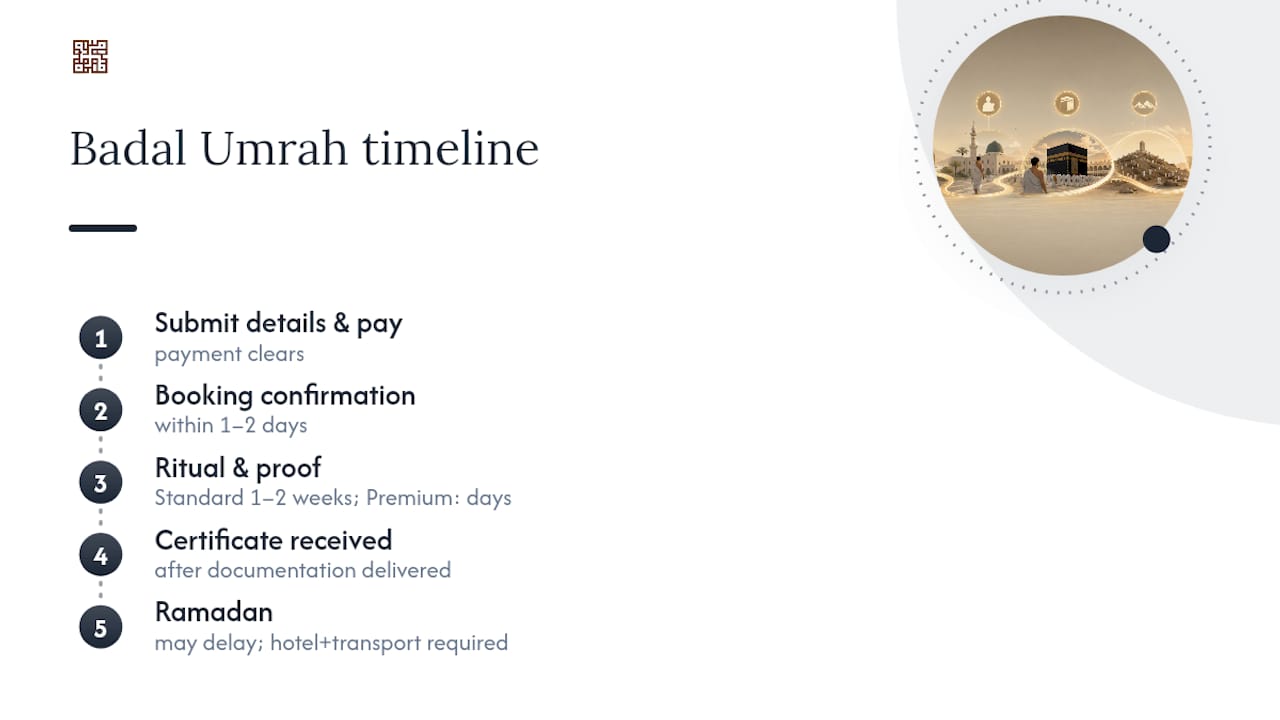
Ramadan changes this math. During the last ten nights especially, Saudi authorities require confirmed hotel and ground transport bookings before any visa is issued, a rule that affects performers traveling to Makkah just as it affects any other pilgrim. That administrative layer, combined with sheer volume, means Ramadan-season orders often take longer to complete and deliver proof than the same package booked in a quieter month.
If you need the certificate by a specific date, whether for a family gathering, an anniversary of a death, or simply peace of mind, say so at booking time rather than assuming standard turnaround will hit your deadline. Providers offering express or premium tiers exist specifically to solve this problem, and it’s a legitimate reason to pay more rather than a wasted upgrade.
How Do You Compare Prices Across Badal Umrah Providers?
Price alone tells you almost nothing until you know what’s included at that price. The smarter comparison method is to normalize by deliverable: line up what each provider gives you for their $250 tier, not just the number itself.
Start by checking whether video is live, recorded, or absent entirely at a given price point, since that’s the single biggest cost driver across providers. Then check whether a certificate is included as standard or sold as an add-on, since some cheaper-looking packages turn out to cost more once you add the documentation most families actually want.
Ask, too, whether the quoted price is genuinely final or whether “processing,” “verification,” or “express” fees get added later. A provider that publishes fixed package pricing on its own site, rather than quoting over email or messaging apps, is generally easier to hold accountable if something goes wrong.
Finally, weigh turnaround time against price. A slightly more expensive package that delivers in five days instead of three weeks might be the better deal if you’re working around a specific date, even though the sticker price looks higher.
What Happens If You Need to Cancel or Reschedule?
Life circumstances change, someone’s health improves, a family reconsiders which relative to prioritize, or a payment issue arises, so cancellation and rescheduling policies matter more than most buyers realize going in.
Before booking, confirm in writing what happens if you need to cancel after payment but before the Umrah is performed. A fair policy generally allows a full or partial refund if the request comes early enough, since no service has been rendered yet. Once a performer has already completed the ritual, refunds typically aren’t available, since the obligation has technically been fulfilled on your behalf, even if you’re unhappy with how documentation was delivered.
Rescheduling, shifting the order to a different beneficiary name or delaying timing, usually carries fewer complications than a full cancellation, but ask specifically whether that incurs any additional fee, particularly if the request comes during a high-demand period like Ramadan. Some providers waive rescheduling fees for tier upgrades but charge for downgrades, so read the fine print rather than assuming symmetry.
The safest approach is simple: get the cancellation and rescheduling terms in writing before you pay, not after something goes wrong.
How Do You Spot Overcharging or Scams in This Space?
The Badal Umrah space has a scam problem for one simple reason: it’s built on trust in something you can’t personally verify. You’re paying someone, sight unseen, to perform a ritual on your behalf thousands of miles away, and that setup attracts opportunists.
The clearest warning sign is a provider that won’t commit to any proof at all, no photos, no certificate, no video option regardless of price. A second red flag is vagueness about who the performer actually is; legitimate providers can tell you, at minimum, that the performer has completed their own obligatory pilgrimage, a condition scholars widely cite as necessary. A third is pressure tactics, urgency around “limited slots” paired with a request to skip standard verification steps.
Community and scholarly voices have also raised a broader concern worth keeping in mind: proxy pilgrimage shouldn’t turn into a purely commercial enterprise where profit motive quietly overtakes the religious obligation being fulfilled. That’s less about any single red flag and more about a general posture, favor providers who are transparent about how the process works and who the performer is, not just ones with the lowest price on the page.
If a quote seems unusually low compared to everything you’ve read here, ask why. Sometimes it’s a genuine promotion; often it’s a missing deliverable you’ll discover only after payment clears.
A Publisher’s View on What Actually Separates Legitimate Providers
Badalumrah operates specifically within the religious and spiritual services space, focused on Badal Umrah for people who genuinely can’t perform the pilgrimage themselves, whether due to illness, old age, or death. That focus shapes how the packages are built: documentation, video, and certificates exist across every tier because proof is the entire point of paying someone else to fulfill this obligation for you.
The scholarly conditions covered earlier, performer qualifications, documented consent, clear niyyah, aren’t a formality tacked onto marketing copy. They’re the actual basis on which a proxy pilgrimage is considered valid in the first place, and a provider that treats them as optional is cutting a corner that matters religiously, not just commercially.
There’s also a charitable dimension worth noting: a portion of profits from these services is pledged toward supporting Gaza, which fits within a broader Islamic framework of channeling commerce toward compassion rather than treating a sacred obligation as pure transaction.
— anas
Ready to Book? Here’s What Each Package Gets You
If you’ve read this far, you already know roughly where your budget lands. Here’s the direct path: the Du’a Package at $150 covers the essentials, certificate and photos, for a single beneficiary. The Noor Package at $250 adds video and is the tier most families settle on. The Barakah Package at $400 expands documentation further, and the Jariyah Premium Package at $500 delivers full video, priority scheduling, and the most complete proof available.
What makes Badalumrah different from piecing this together through an unverified intermediary is straightforward: every tier includes documented performer verification, a certificate of completion, and a stated delivery timeline, so you’re not guessing whether the ritual actually happened or waiting indefinitely for proof. If you’re arranging Umrah for multiple relatives, or you have questions about consent requirements for a living family member, reach out through the FAQ page before you book. Otherwise, pick the package that matches your budget and documentation needs, and submit your beneficiary details today to get the process started.
Sources
- Can You Delegate Someone to Perform `Umrah on Behalf of a Dead Person? - Islam Question & Answer
- What are the rulings on performing Hajj and ‘Umra on behalf of another? - SeekersGuidance
- Performing hajj on behalf of a deceased person - Dar Al-Ifta
- Umrah E-Visa Saudi Arabia Price 2026: Full Guide
- Umrah 2026–2027: The New Nusuk Rules Explained (No Booking, No Visa) | Wadana Go
FAQ
Is Badal Umrah Allowed in Islam?
Yes. Badal Umrah is permissible for deceased individuals and for living people who are permanently unable to perform the pilgrimage themselves, though delegating on behalf of someone physically and financially capable is not permitted. Consent and clear intention (niyyah) matter, especially when the beneficiary is living.
How Much Does Badal Hajj Cost?
Badal Hajj costs more than Badal Umrah because the rites are longer and more involved. Badalumrah’s Hajj Badal packages have published prices reflecting this tiered structure.
What’s the Price of a Two-Person Umrah Package?
Badalumrah prices packages per beneficiary rather than per group, so a two-person order typically means booking two packages, for example, two Noor Packages at $250 each. Higher tiers like Barakah can sometimes accommodate multiple names more efficiently on documentation, so it’s worth asking directly which structure fits your case.
What’s the Total Cost of Umrah?
If you mean paying for someone else to perform Umrah on your behalf, the total badal umrah cost ranges from $150 to $500 depending on tier, plus a Ramadan surcharge if applicable. If you mean traveling for Umrah yourself, that total includes flights, hotel, and visa costs, with visa-related fees alone commonly falling between $33 and $240 depending on nationality and agent use.