- best sadaqah jariyah
Best Sadaqah Jariyah: 6 Lasting Ways to Give, Compared
Published on Oct 21, 2026
Best Sadaqah Jariyah: 6 Lasting Ways to Give, Compared

The best sadaqah jariyah is the one whose benefit keeps flowing to others and that you give with sincerity. Providing water is the act most often named first, but a mosque, a copy of the Qur’an, a gift of knowledge, a tree or an Umrah performed for a loved one can each be the right choice, depending on who you are giving for and what you can afford. This guide compares them side by side so you can choose with a clear heart.
TL;DR
- Water is the classic answer: when asked which charity is best, the Prophet (peace be upon him) pointed to giving water.
- An act counts as jariyah only while its benefit continues, so a one-time meal is wonderful charity but not jariyah.
- For a deceased parent, scholars say du’a is the best gift, and charity on their behalf reaches them too. Do both.
- Umrah on behalf of a deceased or permanently unable person is a valid form of ongoing good, if the person who performs it has already done their own Umrah.
- Our Umrah-on-behalf packages run from $150 to $500, and each comes with documented proof.
Table of Contents
- What makes a charity truly jariyah
- The best sadaqah jariyah options at a glance
- Water: the answer the Prophet gave
- Mosques, Qur’ans and knowledge
- Trees, orchards and smaller gifts
- Giving for a deceased parent or loved one
- Umrah on behalf of a loved one as ongoing good
- Our Umrah-on-behalf packages
- Our perspective: why we recommend combining gifts
- How to choose a provider for any sadaqah jariyah
- A simple plan for your next gift
- FAQ
- Sources
What makes a charity truly jariyah
Sadaqah jariyah means flowing, or ongoing, charity. The hadith most people know says that when a person dies, their deeds end except three: ongoing charity, knowledge others benefit from, and a righteous child who prays for them.
The key word is continuity. According to IslamQA’s explanation of ongoing charity, a charity whose reward does not continue is not sadaqah jariyah. Feeding a hungry family is deeply rewarding, and we should all do it. But a well, a mosque or a planted tree keeps serving people long after the donation is made. That is the test we use throughout this article.
So when you compare options, ask four simple questions:
- Does the benefit continue for years, not days?
- Can I verify that it was actually done?
- Does it fit the person I am giving for?
- Is it a sum I can give without hardship?
The best sadaqah jariyah options at a glance
| Option | Typical cost | How long the benefit lasts | Best for |
|---|---|---|---|
| Water well or water project | From about $390 for a tube well, up to $5,000 for larger projects (UM Relief) | Years to decades | Anyone, especially a deceased parent |
| Building or supporting a mosque | Varies widely by project | Generations | Larger family gifts, group giving |
| Qur’ans and Islamic books | Small to moderate | As long as the copies are read | Smaller budgets, frequent giving |
| Knowledge and education | Varies | As long as students learn and teach | Those who want to support scholars or schools |
| Trees and orchards | Small to moderate | Years, while the fruit is eaten | Gifts in memory of a loved one |
| Umrah on behalf of someone | $150 to $500 with our packages | A completed act of worship with lasting reward for the person it is made for | Deceased relatives, elderly or terminally ill parents |
The costs for wells come from one charity’s published ranges and will differ between organizations and countries. Always ask for current figures before you give.
Water: the answer the Prophet gave
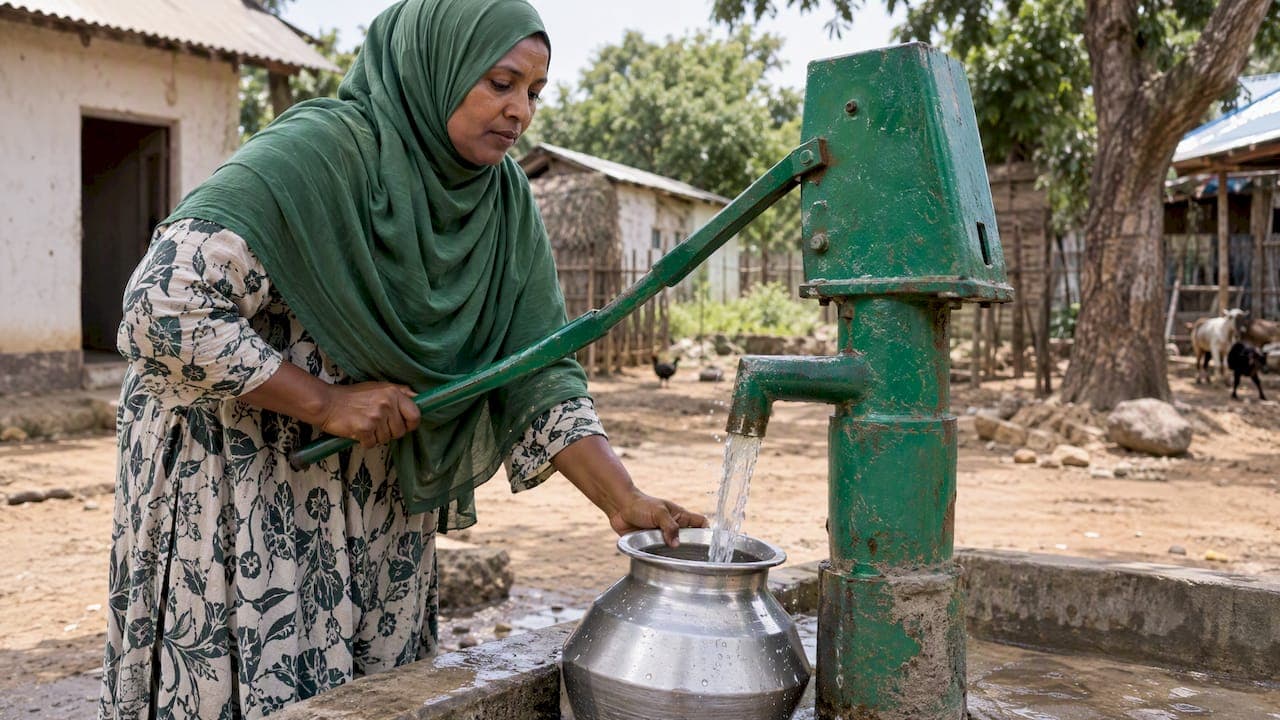
The narration of Sa’d ibn 'Ubadah is the reason water tops almost every list. Sa’d asked which charity was best for his deceased mother. The Prophet (peace be upon him) answered that it was giving water.
That is why so many people choose a well for a parent who has passed away. It is simple, it is easy to understand, and it serves whole villages. UM Relief lists tube wells from $390 and larger projects up to $5,000, with several months between donation and completion.
Strengths: direct hadith support, visible community benefit, a wide range of price points.
Things to check: who builds and maintains the well, whether you receive a report, and whether the project is in a place that really needs it. A well that breaks down in two years is not what you intended.
Mosques, Qur’ans and knowledge
The same hadith that names ongoing charity also names beneficial knowledge. That opens a broad field of choices:
- A mosque or part of one. Funding a prayer space benefits every worshipper who uses it. It usually asks for the largest gift, so many families give together.
- Qur’ans and books. Placing copies in a mosque, school or prison library is accessible at almost any budget.
- Education. Sponsoring a student of knowledge, a teacher or a school keeps the benefit moving from one learner to the next.
These options suit people who want the gift to be spiritual in its very nature. The trade-off is that they are harder to verify from far away, so choose organizations that report back with photos or documents.
Trees, orchards and smaller gifts
Not every sadaqah jariyah has to be large. A tree whose fruit is eaten by people and birds, a water cooler in a public place, or a mushaf given to a neighbor all carry the same idea: a small act whose benefit keeps going. If your budget is modest, start here and repeat the gift often. Consistency matters more than a single large sum.

Giving for a deceased parent or loved one
Many readers come to this topic after a death, so let us be direct about what scholars say.
The Islam Q&A answer on sadaqah jariyah for the deceased states that scholars agree the benefits of du’a, seeking forgiveness, sadaqah jariyah and Hajj reach the deceased. It also says the best thing you can do for a dead parent is to make plenty of du’a for them.
That is a gentle and important balance. Charity does not replace prayer. Your du’a, day after day, is itself part of the legacy. Pair it with one lasting act: a well, a Qur’an, a tree, or an Umrah in their name.
Which one should you choose for your parents?
A practical way to decide:
- If your parent loved a particular cause, choose it. A mother who always gave water to neighbors may be well served by a well.
- If you want a personal act of worship made for them, consider Umrah on their behalf.
- If your budget is limited, give a smaller gift now and keep giving. Even a modest gift is real.
- If several siblings want to give, combine your gifts into one larger project and share the intention.
If you are also thinking about how giving fits into your finances, a charitable giving tax calculator can help you see how donations from a US household might interact with your tax return. Check which organizations qualify with a tax professional before you rely on any figure.
Umrah on behalf of a loved one as ongoing good
The keyword people type most around this topic is how to give for the deceased, and one of the most meaningful answers is Umrah on their behalf. It is a personal act of worship, performed in Makkah, made with the name and intention of the person it is for.

It is not for everyone, and the rules matter. The Standing Committee for Scientific Research and Ifta states that Umrah can be done for someone who is physically unable, but not for someone who is capable of doing it themselves. The same ruling covers those who have passed away. Sheikh Assim Al Hakeem explains that there is nothing wrong with Umrah on behalf of the deceased, or of a living person who is too old or sick with a disease with no hope of recovery.
A few conditions to understand before you book anyone:
- The person must be truly unable. Scholars describe the test as unbearable hardship. A condition that is expected to be temporary and curable does not qualify. The IslamWeb fatwa on physical and financial ability sets this out.
- The representative must have done their own Umrah first. Duaa Guides notes that if they have not, the Umrah counts for themselves and the person you intended does not receive it.
- Ask who will perform it. Sheikh Assim Al Hakeem advises asking whether your representative will do the rites personally or pass the task to someone else. Transparency here is essential.
We have written step-by-step guides for the most common situations: Umrah for a deceased mother, for a deceased father, for deceased parents and the BinBaz rulings, and for an elderly parent. If a relative is still living and permanently unable, read who qualifies for proxy Umrah first. For a recent loss, see our page on timing after a loved one’s death.
Our Umrah-on-behalf packages
We are Badal Umrah. We arrange Umrah on behalf of those who cannot perform it, carried out by a trusted representative in accordance with Islamic law. Every booking is a one-time fee with no recurring charges, and you receive proof of completion: photos, video and a certificate.
| Package | Price (one-off) |
|---|---|
| Du’a Package | $150 |
| Noor Package | $250 |
| Barakah Package | $400 |
| Jariyah Premium Package | $500 |
The packages differ in speed and features, so you can choose the level that suits your situation and budget. If you want to give for someone in the Hajj season, we also offer Hajj Badal, Ifraad at $1500 and Hajj Badal, Tamattu’ with Umrah and Qurbani at $2500. Hajj on behalf of someone follows its own conditions, so read the details before you book.
For You. For Your Loved Ones. For Their Forgiveness.

Our perspective: why we recommend combining gifts
We do not believe there is one winner among sadaqah jariyah options. Families who come to us after a death are usually looking for something they can do, and the answer is rarely a single thing.
What we see is this. People feel peace when they pair a lasting community gift, such as a well or a Qur’an, with a personal act made in the name of their parent. The first keeps benefiting others. The second is an act of worship carried out for the one you love, with documents you can keep and share with your family.
We hold ourselves to a few commitments. Every Umrah is performed according to Islamic rulings and verified by qualified imams. You get real-time updates and documentation, not a promise. And we pledge a portion of our profits to charity, including support for Gaza, because a service about mercy should carry mercy with it.
We also say no where the ruling says no. If a person is physically able and has the means, the obligation is theirs to perform. We would rather guide you to the right choice than take a booking that does not serve you.
— anas
How to choose a provider for any sadaqah jariyah
Whatever you decide to give, the same habits protect your gift:
- Ask for the specifics. Where will the well be built? Who is the representative? What exactly is included?
- Expect proof. A trustworthy provider gives you a report, photos, video or a certificate, not only a receipt.
- Check the religious basis. Look for clear statements of the rulings they follow and who verifies compliance.
- Compare the real cost. Ask whether administrative costs are included and whether the price is fixed.
- Keep your intention sincere. Make the niyyah for the person you are giving for, and keep making du’a.
A simple plan for your next gift
If you are not sure where to begin, here is a plan you can adapt:
- This week: make du’a for your parent or loved one, and give a small gift, such as a Qur’an for a local mosque.
- This month: fund a lasting project, such as a share in a water well.
- When ready: arrange an Umrah on their behalf if they were unable or have passed away, choosing the package that fits.
None of this needs to happen at once. What counts is that you start, and that you keep going.
FAQ
What is the best sadaqah jariyah?
Water is the most commonly cited answer, because the Prophet (peace be upon him) named it when asked which charity was best for a deceased mother. Other excellent choices include supporting a mosque, sharing the Qur’an and funding education. The best one for you is the one that continues to benefit people and fits your means.
Does sadaqah jariyah reach a deceased parent?
Yes. Islam Q&A reports that scholars agree the benefit of sadaqah reaches the deceased. It also says that du’a is the best thing you can give your parent, so make plenty of it alongside your charity.
Is Umrah on behalf of someone a form of sadaqah jariyah?
It is an act of worship done for another, and some scholars and writers describe it among the best ways to benefit the deceased. It is valid for the deceased or for a living person who is permanently unable, but not for someone physically capable of going themselves. It is different from a well or a mosque, which keep serving people. Many families give both.
Can I give sadaqah jariyah for more than one person?
Yes, you can give for several people, for example siblings sharing a gift for a parent. For Umrah, you can read our guide on Umrah for multiple people to see how the intention works. Ask your scholar if you have a specific case.
Sources
- What is the Best Sadaqah Jariyah? The Muslim Vibe
- What Is Sadaqah Jariyah (Ongoing Charity)? Islam Q&A
- Sadaqah Jariyah for the Deceased, Islam Q&A
- Doing Hajj and Umrah on Behalf of Another, IslamHouse
- Physical and Financial Ability to Perform Hajj, IslamWeb
- Can I Perform Umrah for Someone Else? Duaa Guides
- Delegating Someone to Perform Umrah on Behalf of the Deceased, Sheikh Assim Al Hakeem
- Build a Water Well, UM Relief
- Charitable Giving Tax Calculator