- wheelchair umrah ruling
Wheelchair Umrah Ruling: Is It Valid and What to Know
Published on Nov 9, 2026
Wheelchair Umrah Ruling: Is It Valid and What to Know

Yes, Umrah performed in a wheelchair is valid. Scholars across the schools permit a pilgrim who cannot walk, or who walks only with real pain, to be pushed or carried through tawaf and sa’i, and the rites stay the same. If travel itself is no longer possible, the scholarly tradition also allows a trusted representative to perform Umrah on your behalf. This guide sets out both paths, with the rulings and the practical details.
TL;DR
- Tawaf and sa’i in a wheelchair are permissible for anyone with a genuine excuse such as illness, old age or pain. No penalty is owed.
- Walking is the default. The permission to ride or be pushed rests on real need, so be honest about what you can manage.
- The person pushing you does not need to be a mahram. Each of you holds your own intention.
- If a person cannot travel or cannot even be pushed, Umrah may be performed on their behalf by someone who has already done their own.
- Access rules at the Haram, such as which floor wheelchairs use, are administrative arrangements and not part of the religious ruling.
Table of Contents
- What the ruling says
- Tawaf and sa’i: how to perform them seated
- The person pushing: ihram, intention and who may help
- What the Haram offers wheelchair users
- When travel is not possible: Umrah on someone’s behalf
- Choosing between a wheelchair and a representative
- Arrange Umrah on behalf of someone you love
- FAQ
- Sources
What the ruling says
The starting point is a distinction scholars draw clearly. In principle, walking during tawaf is obligatory (wajib) for the one who is able. When a person is genuinely unable to walk, or walking causes real pain, sitting in a wheelchair is permitted and no penalty or monetary compensation is due, according to Mufti Faraz Adam of Darul Fiqh. A South African Hanafi fatwa makes the same point: a valid excuse such as disability or illness allows a wheelchair, and a golf cart is permissible when the person’s condition requires it.
The evidence goes back to the Prophet ﷺ. Islamhelpline cites the narrations in Bukhari and Muslim that he performed tawaf and sa’i while riding his mount. It concludes that a wheelchair user stands in the same position as someone riding a camel, and that there is no harm in it when old age or another valid reason applies.
The Hanafi reasoning is simple. The pillar of tawaf is that it takes place around the Kaaba, whether by your own action or by being carried. Where there is incapacity, there is no obligation, so nothing is owed.

Does a wheelchair change any of the rites?
No. The structure is the same: ihram at the miqat, seven circuits of tawaf, seven laps of sa’i, then cutting the hair. The wheelchair changes how you move, not what you do.

The ihram restrictions apply as usual. Dar al-Iftaa al-Misriyyah lists them: covering the head, shaving or pulling hair, paring nails, using perfume, conjugal relations, wearing sewn garments and hunting. It adds that a necessity can allow what is otherwise forbidden, with a fidya due in that case. If your medical needs make the ihram garments difficult, ask a qualified scholar about your own situation before you travel.
Tawaf and sa’i: how to perform them seated
Here is what the rulings mean in practice.
- Make your own intention. The pilgrim in the wheelchair intends tawaf and sa’i for themselves. Islamweb states that the grandmother must hold the intention herself, and that pushing does not affect the validity of either person’s worship.
- Keep the Kaaba on your left. The direction and the seven circuits do not change.
- Supplicate as you would on foot. Your du’a, dhikr and recitation are yours. Nothing in them depends on who is pushing.
- Sa’i between Safa and Marwa. The World Federation’s OneStopFiqh says walking in sa’i is better but not necessary, and that riding, being carried or being pushed in a wheelchair is permissible.
- Finish with the hair. Men shave or trim, and women trim, as for any pilgrim.
Rest between the rites
Nothing in the Sharia requires Umrah to be done in a single push. Umrah Guide notes that mainstream scholarship permits resting between tawaf and sa’i, and that many scholars allow sa’i to be delayed to later the same day or the next. For an elderly pilgrim, that can be the difference between a calm Umrah and an exhausting one. If you plan to split the rites, confirm the details with your own scholar or group leader first.
Being carried, and the precaution some scholars mention
OneStopFiqh (Ritual 326) adds a precaution for the Shia position: if you cannot do tawaf yourself, you may be carried or pushed, and as a matter of precaution carried in a way that your feet touch the ground where possible. If even that cannot be done, the ruling there is to hire an agent to perform the tawaf for you. Anyone following a particular school should read their own marja’ or mufti on this point.
The person pushing: ihram, intention and who may help
This is the question families ask most. Three points answer it.
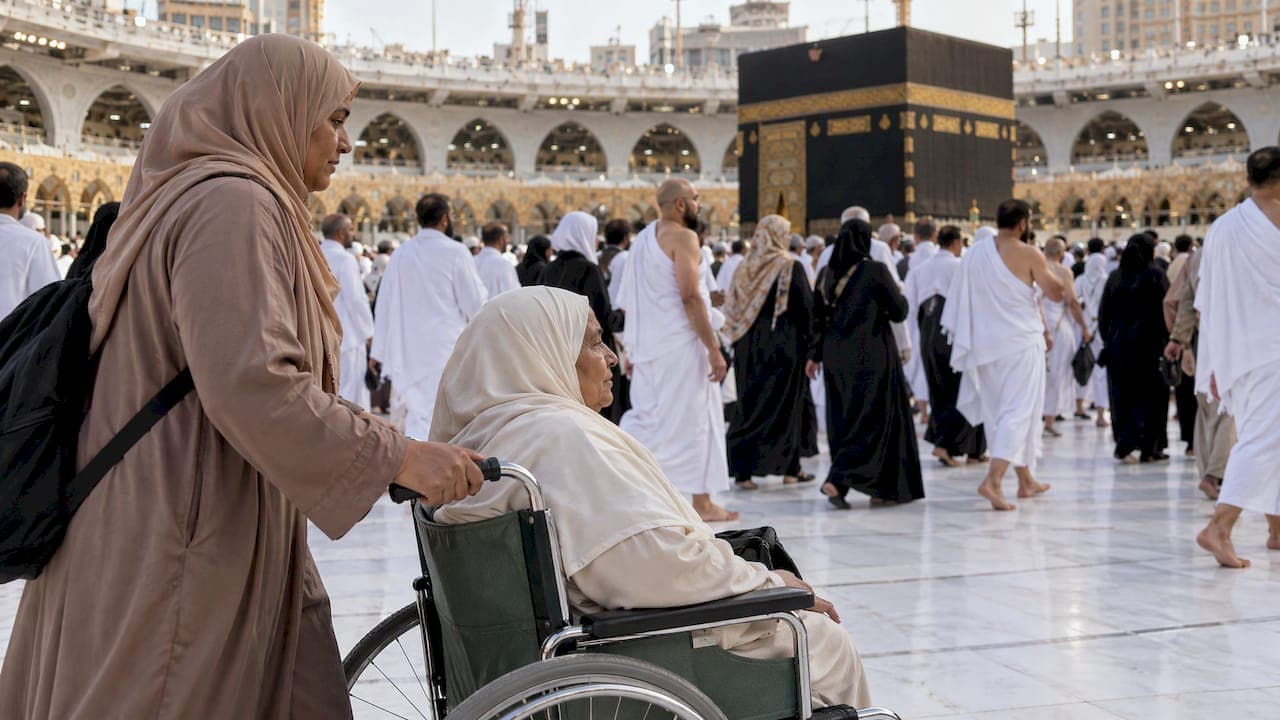
The helper does not need to be a mahram. Islamhelpline states there is no condition in the Sharia that the wheelchair be pushed by a mahram relative. A relative may push, and a hired helper may push too. Many pilgrims hire a licensed pusher at the Haram for this reason.
Your helper can count it as their own tawaf. According to Islamweb, the person pushing should hold the intention of tawaf and sa’y for himself, and each person’s intention stands on its own. A fatwa from the Permanent Committee, published on Al-Feqh, says a son pushing his mother may also make the intention for his deceased father at the same time. Some guidance recommends instead that companions do their own tawaf separately, so follow the view of the scholar you trust.
Ihram applies to the one performing Umrah. A helper who is doing the rites for themselves enters ihram at the miqat like any other pilgrim. A hired pusher who is simply working there is in a different position from a family member making Umrah. For your exact situation, ask your mufti.
If you are planning the journey to the airport and hotel, safe vehicle transfers matter as much as the rites. A practical guide to car transfer for wheelchair users explains the methods and aids caregivers use, and it is worth reading before a long trip.
What the Haram offers wheelchair users
These are access arrangements, not rulings. They can change, so confirm them close to your travel date.
- Official Umrah guide. The Saudi Ministry of Hajj and Umrah states that if someone cannot do tawaf or sa’i on foot, manual wheelchairs and golf carts are available inside the Grand Mosque, with designated entrances and pathways.
- Free and paid tracks. Gkomunika reports that the General Authority for the Affairs of the Two Holy Mosques runs free and paid wheelchair services around the clock. Its 2026 figures list SAR 100 for tawaf only, SAR 100 for sa’i only and SAR 250 for both before the Hajj peak, rising to SAR 500 to 600 afterward. It also reports that paid bookings have gone through the Tanaqol app since March 20, 2025.
- Floors. Wheelchairs are generally not permitted on the ground-floor mataf at busy times, so users usually perform tawaf on the first floor or the roof. Those circuits are longer and take more time.
- Madinah. The Ministry’s page on the Prophet’s Mosque lists the gates where wheelchairs are available, including Al-Salam Gate, King Fahd Gate and King Saud Gate.
A useful planning habit comes from Umrah Guide: decide about the wheelchair at home, not halfway round the Kaaba. A ground-floor tawaf can run to two kilometres or more once crowds push you outward, and sa’i adds roughly three more. If an elder cannot comfortably walk that far at home, plan the wheelchair from the start.
If you are flying in, an arrival plan helps too. A guide on airport pickup for elderly travellers shows how families pair assistance at the airport with a prearranged transfer.
When travel is not possible: Umrah on someone’s behalf
A wheelchair solves the problem of walking. It does not solve every problem. Some people are too ill to leave home, or are bedridden, or have passed away. For them, scholars describe a second path: badal, or Umrah performed on behalf of another.
A living person who cannot travel
The Jordan Iftaa’ Department rules that when a person cannot perform Hajj or Umrah because of an illness not expected to be cured, or old age, they may appoint someone to do it for them. The conditions are the person’s own consent and a representative who has already performed Umrah for themselves. It adds that, in the Shafi’i school, delegation is even obligatory for those who owe a mandatory Hajj or Umrah.
Dar al-Iftaa al-Misriyyah makes a related point: a physical disability alone does not change the obligation. The person either travels or commissions someone to do it on their behalf. Shaykh Ibn Baz’s fatwa, citing Tirmidhi 930, confirms that Umrah on behalf of an elderly or sick person whose recovery is not expected is permissible.
We cover the details for families in our guides to documented proxy Umrah for a permanently unable relative, Umrah for a terminally ill person and Badal Umrah for an elderly parent.
A deceased person
The Permanent Committee (Fatwa No. 18808) states that it is permissible to perform Umrah for a deceased person if the performer has already done their own Umrah of Islam, and that its reward reaches the deceased if Allah accepts it. Our guide to Umrah for deceased parents walks through the steps.
Where the schools differ
Duaa Guides summarizes the main positions. In the Hanafi view, a proxy who has not done their own Umrah first is disliked but the act is still valid. In the Shafi’i and Hanbali schools the proxy must have completed their own first, otherwise the act counts as their own. The Maliki school discourages the practice but considers it valid if carried out. Our overview of Badal Umrah rulings by madhhab compares them side by side.
Choosing between a wheelchair and a representative
| Situation | Scholarly path |
|---|---|
| Can travel, cannot walk far | Perform tawaf and sa’i in a wheelchair or on a cart. No penalty. |
| Can travel but not be pushed or carried | Some scholars, such as in OneStopFiqh, direct you to appoint an agent. Ask your mufti. |
| Cannot travel, illness not expected to improve | Appoint a representative who has done their own Umrah, with your consent. |
| Deceased relative | Heirs or relatives arrange a representative who has done their own Umrah. |
If you are unsure which row applies to you or your parent, speak to a qualified scholar or your local imam. Your doctor can tell you what travel is realistic, and the scholar can tell you what the ruling is for that situation.
Our perspective
We meet this question from families every week, and it usually comes with worry. A mother who wanted to see the Kaaba all her life can no longer manage the flight. A father is too weak even to be pushed round the mataf. A relative has passed away with the wish unfulfilled.
The rulings are kind. They give a person who can travel a way to complete the rites seated, and they give a person who cannot travel a way to have the rites done for them. We built our service for the second case. Every Umrah we arrange is performed in line with Islamic rulings, verified by qualified imams, and documented with photos, video and a certificate, so the family can trust what was done.
We would rather you ask the question early and calmly than late and in grief. Intention, consent and sincerity matter most, and we handle the rest with care.
anas
Arrange Umrah on behalf of someone you love
If your parent, spouse or relative cannot travel, or you want Umrah performed for someone who has passed, we can arrange it. Our packages are one-off fees with no recurring charges: the Du’a Package is $150, the Noor Package is $250, the Barakah Package is $400 and the Jariyah Premium Package is $500. Each includes proof of completion.

When you are ready, you can book your Umrah here. If you want to understand the eligibility rules and proof first, read our guide to Saudi fatwas, eligibility and proof before you pay.
FAQ
Is my Umrah accepted if I do tawaf in a wheelchair?
Yes. Scholars permit it when you are genuinely unable to walk or walking causes real pain, and no penalty is owed. Make your own intention and perform the same seven circuits and seven laps of sa’i.
Does the person pushing my wheelchair have to be a relative?
No. Islamhelpline states there is no condition that a mahram push the wheelchair, and a hired helper is also fine. The person pushing holds their own intention if they are performing Umrah as well.
Can I be pushed on the ground floor of the mataf?
Usually not at busy times. Wheelchair users are generally directed to the first floor or the roof, where the circuits are longer. Check the current arrangements with the Haram authorities or your group when you arrive.
Can someone perform Umrah for me if I am alive but too ill to travel?
Yes, according to the Jordan Iftaa’ Department, if your illness is not expected to be cured or you are very old. You must consent, and the representative must already have performed Umrah for themselves. Ask a qualified scholar about your own case.
Do all schools agree on proxy Umrah?
They agree it is valid but differ on details. The Hanafi school allows it even if the proxy has not done their own Umrah first, though it is disliked. The Shafi’i and Hanbali schools require the proxy to have completed their own first, and the Maliki school discourages it while accepting it if done.
Sources
- Umrah in a Wheelchair: Guide for Disabled Pilgrims
- Can I sit on a wheelchair to do Tawaf? (IslamQA)
- Tawaf on a wheel chair or golf cart (Darul Ihsan)
- Islamhelpline: elderly mother and tawaf
- The Rites of Hajj and 'Umrah Booklet (Dar al-Iftaa al-Misriyyah)
- Islamweb: pushing a wheelchair and the validity of tawaf and sa’y
- OneStopFiqh, Ritual 337
- OneStopFiqh, Ritual 326
- Umrah for Elderly Pilgrims (Umrah Guide)
- Al-Feqh: helping a handicapped mother on a wheelchair
- Official Umrah Guide (Saudi Ministry of Hajj and Umrah)
- Wheelchairs at Masjid al-Haram: Free or Paid? (Gkomunika)
- Information about the Prophet’s Mosque (Haj.gov.sa)
- Iftaa’ Department of Jordan: delegating Hajj or Umrah for a sick person
- Ibn Baz: Umrah on behalf of another
- Permanent Committee, Fatwa No. 18808
- Can I Perform Umrah for Someone Else? (Duaa Guides)
- Car Transfer for Wheelchair Users
- Airport Pickup for Elderly Travellers