- mecca resident as proxy
Can a Mecca Resident Perform Umrah as Your Proxy?
Published on Nov 19, 2026
Can a Mecca Resident Perform Umrah as Your Proxy?

Yes. A person who lives in Mecca can perform Umrah on your behalf, and so can a trusted Muslim from any other country. The scholarly sources we reviewed set no rule that the proxy must come from your country or be related to you. The conditions that matter are about the proxy’s own Umrah or Hajj, your own situation (deceased, or permanently unable to travel), and the sincerity and accuracy of the rites. If you cannot travel, we arrange this for you through our Du’a, Noor, Barakah and Jariyah packages, each with documented proof of completion.
TL;DR
- A proxy may live in Mecca, Jeddah or any other country. Rulings quoted below find no proof that proxy and principal must share a nationality.
- The proxy should have performed his or her own Umrah or Hajj first, and must be a Muslim of sound mind who knows the rites.
- Proxy Umrah is for the deceased or for someone permanently unable to travel. A person who is merely busy, or able but poor, is not covered.
- A Mecca resident starts ihram at a different miqat (al-Hill, outside the Haram boundary) than a pilgrim arriving from abroad. This does not affect validity.
- Each Umrah is for one named person. Ask for proof of completion before you pay.
Table of Contents
- Does the proxy have to be a Mecca resident?
- Who can be your proxy: the conditions that do matter
- Who may have Umrah performed for them
- The miqat question: where a Mecca resident starts
- What the proxy must do, step by step
- Do the schools of thought differ?
- How to arrange it when you live far from Mecca
- Promo: Umrah performed for you, with proof
- Our perspective
- FAQ
- Sources
Does the proxy have to be a Mecca resident?
No. Many people search for a Mecca resident because they assume proximity is required. It is not. Living near the Kaaba is a convenience, not a condition.
The International Fatwa Authority addresses a person in Malaysia who wants someone else to perform a pilgrimage for him. It says he may authorize anyone from any location, even a friend in Riyadh or Makkah, for a fair wage. The ruling is written about Hajj, but the same reasoning is applied to Umrah, since the two proxy rulings run in parallel in the sources below. The proxy does not need to be from the principal’s village, but he must have performed his own obligatory Hajj.
A ruling published on Al-Fiqh.com goes further on geography. It says it is permissible to authorize a man from India for a deceased person from Kuwait, and also to authorize someone living in Jeddah or Makkah for a person in a remote country. It finds no proof that the two must belong to the same country, even if the proxy’s country is closer to Makkah.
So the answer to the second question people ask, whether a proxy can be from a different country, is also yes. What matters is who the person is, not where the passport comes from.
Who can be your proxy: the conditions that do matter
The rulings agree on a short list. Here it is in plain terms.
- The proxy has done his or her own pilgrimage first. Adil Salahi, writing in Arab News, says the only condition for the hired person is that he has already done his own pilgrimage. He cites the hadith of Shubrumah, where a man was told to perform Hajj for himself before doing it for another.
- The proxy is a Muslim of sound mind, trustworthy, and knows the rites. A summary of the rulings at Duaa Guides lists these qualities, along with physical capability.
- The proxy does not need to be a relative. The Islamweb fatwa states that any person who has already performed Hajj and Umrah for himself can do so for another, and it quotes the Shafi’i scholar al-Ramli on the stranger performing Hajj for a dead person.
- The proxy may be a man or a woman. Arab News notes that a person may hire a man or woman. If this is your question, our guide to the eligibility rules for a female Umrah proxy covers it in detail.
The proxy’s expenses can be covered by you, by the proxy as a gift, or by a third party. Duaa Guides says it is not required that the person being represented pay for the journey.
Who may have Umrah performed for them
This is the part that decides whether proxy Umrah is right for your situation, so it is worth reading slowly.
The deceased. Umrah may be performed for someone who has passed away. Shaykh Ibn Baz ruled that Umrah for a deceased person or one unable to reach Makkah through old age is permissible, just as proxy Hajj is. If you are acting for a parent, our guide on Umrah for a deceased mother walks through the niyyah (intention) and the steps.
The living who cannot travel. The Standing Committee for Scientific Research and Ifta ruled that a proxy is correct for one who is physically unable, and for the deceased. It added that one who cannot come for financial reasons is not obliged to do Hajj or Umrah. Illness that is not expected to improve and advanced old age are the usual examples. If this is your family’s situation, see our steps for arranging Umrah for a terminally ill person.
Not for the able. The same Standing Committee ruling says it is not correct to do Umrah on behalf of someone who is physically able to do it himself. IslamQA’s answer on the subject repeats this. If you are healthy and simply cannot take time off, the rulings point you toward making the trip yourself when you can.

Consent. Scholars distinguish between the dead and the living. Duaa Guides says the appointer must obtain the explicit permission of a living incapacitated person, while permission is not needed for the deceased. SeekersGuidance, quoting a Shafi’i source, explains that consent of the living person is required because he is alive and has free will.
The miqat question: where a Mecca resident starts
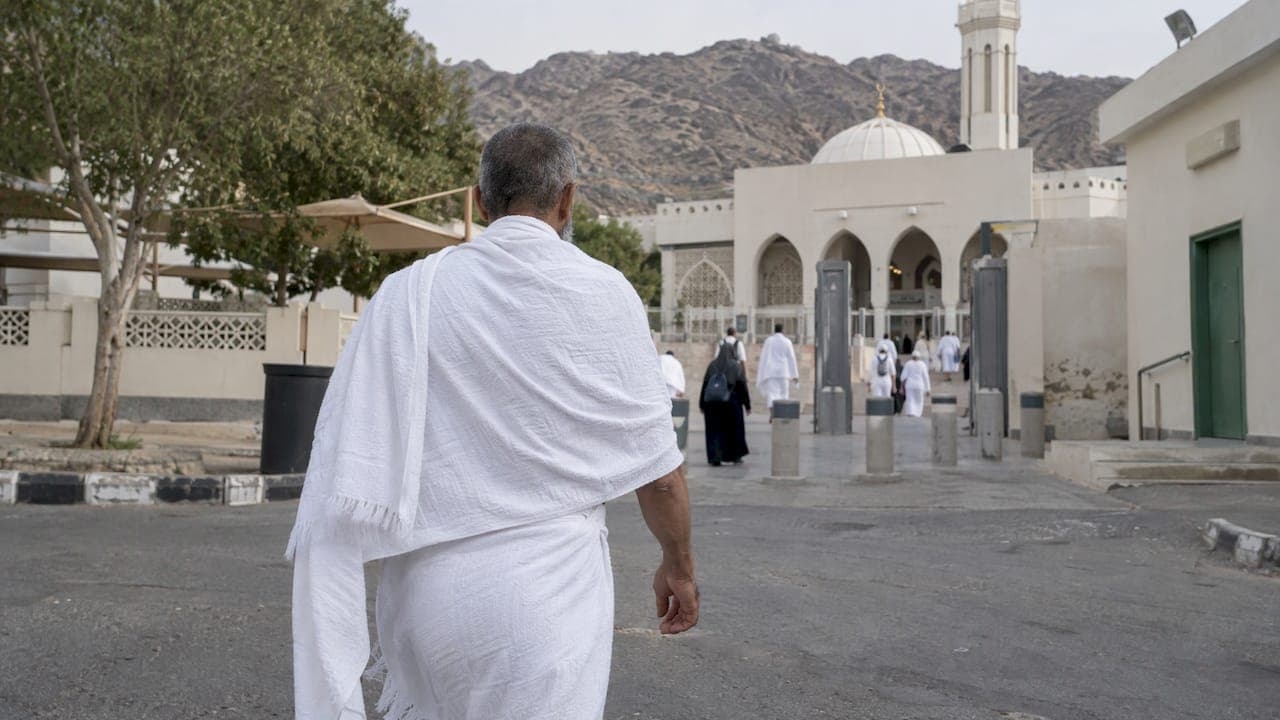
Here is the practical difference a Mecca resident brings. The miqat is the place where a person must enter ihram, the state of consecration for Umrah. Pilgrims from abroad cross one of the fixed miqat stations on their route. Egypt’s Dar al-Ifta explains that residents of Mecca go to al-Hill for Umrah, with at-Tan’eem being the sunnah, while non-residents use stations such as Dhul Hulaifa, Al-Juhfa, Yalamlam, Qarn al-Manazil or Dhat Irq, depending on direction. A resident of Jeddah’s miqat is his own home.
This means a Mecca-based proxy does not travel to Dhul Hulaifa or Yalamlam. He exits the Haram boundary, enters ihram there, returns to the Haram, and completes the rites.
A proxy who is already in Mecca for another Umrah is covered by the same logic. Islam Online’s fiqh article says such a pilgrim need not return to the original miqat outside the country but must go beyond the Haram boundary to the miqat of Makkah’s people, for example Masjid Aisha in Tan’eem.
That is why a proxy living in Mecca is practical, but not required. The rites are the same wherever the proxy begins.

What the proxy must do, step by step
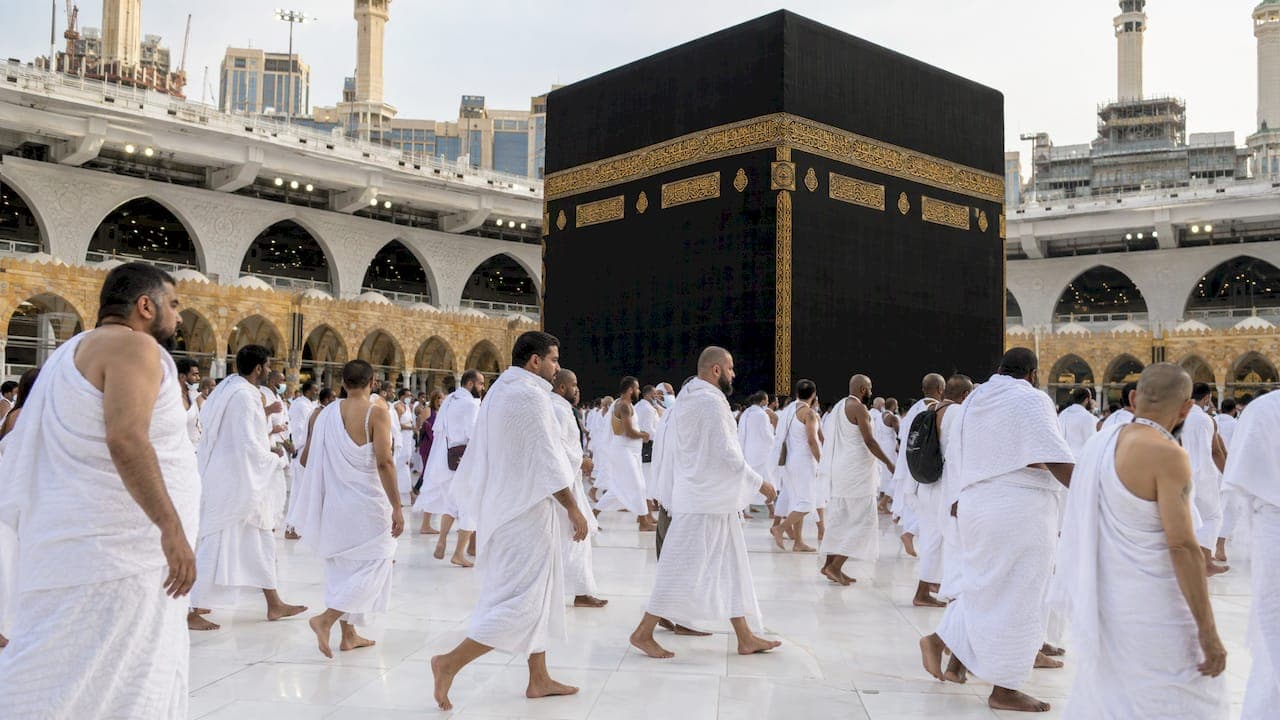
The proxy performs a full Umrah, with your name in mind. The core steps are these:
- Niyyah and ihram. The proxy forms the intention for you at the miqat. Ibn Baz says the proxy enters ihram on behalf of the deceased and preferably says in the talbiyah that he is responding with Umrah for so-and-so. He also notes that intending it in the heart is enough, so the spoken words are not a condition of validity.
- Tawaf. Seven circuits around the Kaaba, followed by two rak’ahs behind Maqam Ibrahim.
- Sa’i. Seven laps between Safa and Marwa.
- Cutting the hair. This completes the Umrah.
The proxy should also keep to the rules of ihram throughout. People preparing for Umrah often ask about fragrance, and the question of whether perfume is halal comes up often before ihram.
One Umrah is for one person. Darul Iftaa, a Hanafi body in South Africa, states that where someone specifically asked for an Umrah to be done for him, the intention may not be made for more than one person in that Umrah. If your family wants Umrah for several people, each needs a separate Umrah. Our article on multiple proxy Umrahs and separate intentions explains how this works.
Do the schools of thought differ?
They agree on the principle and differ on details. According to Duaa Guides:
- The Hanafi school permits proxy Umrah but considers doing it before one’s own Umrah makruh tahrimi, a strongly disliked act.
- Shafi’i scholars treat it as obligatory for someone unable through incurable illness or old age, and require the living person’s consent.
- The Hanbali school requires the proxy to have completed his own obligatory Umrah first, or the act counts as his own.
The safe course across all of them is the same: choose a proxy who has already completed his own Umrah, have the intention made for one named person, and obtain the consent of a living principal. A proxy who meets all three conditions satisfies the views above.
How to arrange it when you live far from Mecca
Most families who ask this question are not in Saudi Arabia. They are in the US, the UK, Canada, Australia or elsewhere, and they need someone in Mecca to act for them. The real work is not finding any person who can go. It is knowing that the Umrah was done, done correctly, and done for the right name.
Our guide on arranging Umrah by proxy from abroad covers the whole process. In short, you should settle these points before paying:
- Eligibility. Confirm your situation fits: the deceased, or a living person with a permanent inability to travel.
- Consent. If the person is alive, obtain their agreement.
- The name or names. Give the full name of the person the Umrah is for.
- Proof. Decide what completion evidence you will receive. Our article on the four completion proofs to expect lists them.
- The rulings. Our overview of Saudi fatwas and eligibility for Badal Umrah sets out the scholarly basis.
Promo: Umrah performed for you, with proof
We carry out Umrah on behalf of you or a loved one, performed by a trusted representative and in line with Islamic legal standards. Every package comes with proof of completion, including photos, videos and a certificate, and our customer support team stays with you through the booking.
Pricing is a one-time fee per booking, with no recurring charges:
| Package | Price | Page |
|---|---|---|
| Du’a | $150 | Du’a Package |
| Noor | $250 | Noor Package |
| Barakah | $400 | Barakah Package |
| Jariyah Premium | $500 | Jariyah Premium Package |
The packages vary in speed and features. You can compare them and book on our Umrah booking page. If you are looking for Hajj on behalf of someone, we also offer Hajj Badal pre-booking.
Our perspective
Families rarely come to us asking about miqats. They come with a name, a loss or a long illness, and one question: can this be done properly for the person I love?
Our answer is that where the proxy lives matters far less than whether the Umrah is performed correctly and with sincerity. Every Umrah we arrange is performed in accordance with Islamic law, verified by qualified imams, and documented from start to finish. You receive real-time updates and the proof of completion, so you are not left wondering.
That is what we mean by transparency. A certificate, photos and video are not decoration. They let a daughter or a son, an elderly parent or a grieving family, rest in the knowledge that the rites were completed for the name they gave us.
We also pledge a portion of our profits to ongoing charity, including support for Gaza, because we believe an act of worship done for others should carry kindness beyond the Kaaba. For you. For your loved ones. For their forgiveness.
anas
FAQ
Can a proxy be from a different country than me?
Yes. A ruling published on Al-Fiqh.com finds no proof that proxy and principal must belong to the same country. The International Fatwa Authority likewise says you may authorize anyone from any location. The proxy’s own Hajj or Umrah must already be complete.
Does the person doing Umrah for me need to be a relative?
No. The Islamweb fatwa says it is not a condition that the doer be a relative. Any Muslim who has already performed Hajj and Umrah for himself can do it for another person.
Can I send a proxy if I am healthy but cannot get a visa?
Islam Online’s fiqh article states that prominent scholars permit a pilgrim to offer Umrah for a healthy relative who cannot enter Saudi Arabia because of visa restrictions. Others, such as the Standing Committee, say proxy is for the physically unable and the deceased. Because scholars differ here, we recommend you consider your own situation carefully against these rulings before booking.
Can one Umrah cover several family members?
No. Where a specific person has asked for Umrah to be done for him, the intention should not be made for more than one person in that Umrah. Book a separate Umrah for each name.
Do I need permission from the person I am sending Umrah for?
If the person is alive, scholars of the Shafi’i school say you need their consent. For someone who has died, permission is not required.
Sources
- Egypt’s Dar al-Ifta: The Rites of Hajj in Detail
- International Fatwa Authority: proxy for Hajj and Umrah from a distance
- Al-Fiqh.com: Authorizing a man from India to perform Hajj for a deceased person from Kuwait
- Arab News: Expatriates and Substitute Pilgrimage and Umrah
- Islamweb: Performing Umrah for others
- Duaa Guides: Can I Perform Umrah for Someone Else?
- Al-Fatawa: Permissibility of performing Umrah on behalf of the deceased or incapable
- Islamhouse: Doing Hajj and Umrah on Behalf of Another
- IslamQA: Doing Hajj and Umrah on behalf of another
- SeekersGuidance: Rulings on performing Hajj and Umra on behalf of another
- Islam Online: Umrah on Behalf of Others, Visa Issues
- Darul Iftaa: Can you perform tawaf/umrah for someone else
- HSA Perfumes: Is Perfume Halal?