- umrah for living person
- umrah on behalf while alive
- umrah intention for living individuals
- performing umrah for others
- how to perform umrah for someone
- can you do umrah on behalf of someone
- umrah pilgrimage for someone else
- spiritual significance of umrah
- benefits of umrah for living
- can i do umrah for someone alive
Only for Permanently Unable Relatives: Documented Proxy Umrah in Saudi
Published on Sep 4, 2026

Only for Permanently Unable Relatives: Documented Proxy Umrah in Saudi

Yes, but only under one condition: the person must be chronically or permanently unable to perform Umrah themselves, whether from advanced age, severe illness, or lasting disability. Proxy Umrah for a living person who is healthy and capable is not permissible under mainstream scholarly rulings. This applies to voluntary (nafl) Umrah rather than an obligatory duty, and the evidence behind this ruling is worth understanding before you arrange one.
TL;DR:
- Proxy Umrah for a living person is only valid if the individual cannot perform it due to permanent age, illness, or disability, not for temporary or financial reasons.
- The representative must have completed their own Umrah beforehand, explicitly intend the act on behalf of the person, and provide verifiable proof of performing the rites.
- Eligibility requires clear evidence of chronic incapacity, such as advanced age, irreversible illness, or permanent disability, rather than temporary health issues or lack of funds.
- Transparency in the delegation process is crucial, including documented proof, to prevent subcontracting or misrepresentation that could invalidate the proxy.
- Proper vetting of the representative involves confirming their own Umrah completion, reputation, and their willingness to provide documentation like photos, videos, and certificates.
Table of Contents
- What Is Umrah Badal, and How Is It Different From Doing It Yourself?
- What Do the Fatwas Actually Say About This?
- Does the Person You Have in Mind Actually Qualify?
- How Does the Representative Actually Perform Umrah on Someone’s Behalf?
- How Do You Choose a Trustworthy Representative?
- Where Does Badal Umrah Fit Into This Picture?
- Our Take: What Actually Matters Here
- Ready to Arrange a Verified Umrah for a Loved One?
- Sources
What Is Umrah Badal, and How Is It Different From Doing It Yourself?
Umrah Badal means one person performs the rites of Umrah while explicitly intending the reward for someone else. The practice traces back to hadith reports about pilgrims asking the Prophet Muhammad (peace be upon him) whether they could perform Hajj or Umrah for a relative too old or too sick to travel, and receiving permission. It is not a new workaround invented for the travel industry. It is a recognized category of worship-by-proxy with its own conditions.
Three distinct acts get confused constantly, and the differences matter for validity:
- Performing Umrah for yourself — the standard, default act of worship.
- Gifting the reward of your own completed Umrah to someone else, living or deceased, without acting as a formal proxy.
- Performing Umrah as a proxy (badal) — where the pilgrim enters Ihram with explicit intention on behalf of a named person who could not do it themselves.
The third category is what most people mean by “Umrah for a living person,” and it carries the strictest conditions of the three. Gifting reward has more scholarly flexibility. Acting as a proxy does not.
What Do the Fatwas Actually Say About This?
The dominant scholarly position, drawn from multiple contemporary rulings, is narrow and specific: proxy Umrah for a living person is valid only when that person suffers from a permanent or chronic barrier to performing it themselves. Islam Q&A’s ruling on Umrah for the living states this plainly. Someone who is merely busy, financially stretched for this particular trip, or temporarily unwell does not qualify. The barrier has to be lasting.

That single distinction resolves most of the confusion people bring to this topic.
The condition in one line: Proxy Umrah is a remedial allowance for permanent inability, not a preferred substitute for someone who could eventually go themselves.
Where scholars diverge is mostly around voluntary (nafl) Umrah performed on behalf of a living person who has no religious obligation to perform it at all. Some scholars permit this more liberally as an act of goodwill between family members, while others hold the same chronic inability standard applies regardless of whether the Umrah is obligatory or optional. IslamWeb’s fatwa on Umrah on behalf of the living draws this same line between gifting reward and formal proxy performance, noting that consent from the living person matters in a way it obviously cannot for the deceased.
Practically, this means: when in doubt, apply the stricter standard. It costs nothing to be conservative here, and it protects the validity of the act.
Does the Person You Have in Mind Actually Qualify?
Run through this checklist before arranging anything on someone’s behalf:
- Advanced old age with physical incapacity. A parent who can no longer walk long distances or endure the physical demands of Umrah rituals typically qualifies.
- Chronic or irreversible illness. Conditions like advanced kidney disease, paralysis, or degenerative disorders that make travel medically unsafe meet the standard.
- Permanent disability. Not a temporary injury that will heal, but a lasting physical limitation.
- Financial inability is a separate question. Someone who cannot afford the trip has a different problem than someone who is physically incapable, and most scholars do not treat lack of funds alone as grounds for proxy Umrah in the same way as chronic illness. Financial hardship is a matter for charity or family support, not proxy rulings.
- Consent from the living person. Unlike Umrah for the deceased, the living individual should generally know and agree to someone performing it on their behalf. This is where family-authority questions get delicate. An adult child cannot unilaterally decide on behalf of a mentally capable parent without asking.
- Obligatory versus voluntary status. Umrah itself is not obligatory the way Hajj is for those who meet the conditions, so most proxy cases here involve voluntary acts of devotion rather than fulfilling a fixed religious duty.
Badalumrah’s guide on who can request proxy Umrah walks through these same eligibility markers in more detail if you want a second reference point.
How Does the Representative Actually Perform Umrah on Someone’s Behalf?
The mechanics matter as much as the eligibility. Here is the order of operations:
- Confirm the representative has performed their own Umrah first. This is a widely held condition in contemporary fatwas, including Islam Q&A’s ruling on delegating Umrah: someone should have completed their own obligation or voluntary Umrah before acting as a proxy for another.
- Set the intention (niyat) explicitly and by name. At the point of entering Ihram, the representative states, silently or audibly, that this Umrah is being performed on behalf of the specific named person. Vague or generic intentions do not satisfy the requirement.
- Perform the rites in the standard sequence. Ihram with declared proxy intention, tawaf around the Kaaba, sa’i between Safa and Marwah, then the cutting or shaving of hair to close the rites. Nothing about the physical sequence changes because it is done by proxy.
- Request documentation at each stage. Ask for photos during tawaf, video of key moments, and a completion certificate naming the person on whose behalf the Umrah was performed.
Pro Tip: Ask the performer to state the niyat clearly enough that it could be recorded or witnessed. One contemporary scholar has noted that documenting the performer’s identity and having them state intention in a verifiable way removes ambiguity that otherwise leaves the act’s validity in question.
Badalumrah’s own step-by-step process guide mirrors this sequence and shows what the documentation typically looks like in practice.
How Do You Choose a Trustworthy Representative?
Vetting the person who performs on someone’s behalf is where most of the real risk sits, not in the rulings themselves. Start with three non-negotiables: has this person completed their own Umrah, do they have a track record or reputation you can verify, and are they upfront about exactly who will perform the rites?
That last point deserves attention. Some intermediaries accept payment claiming they will personally perform the Umrah, then quietly hand it off to someone else without telling the family. Scholarly guidance on delegating Umrah treats this kind of hidden subcontracting as a serious problem, one that can affect both the trustworthiness of the transaction and the religious standing of the act itself.
Watch for these red flags:
- No offer of photos, video, or a completion certificate.
- Vague or evasive answers about who will actually perform the rites.
- Unexplained fees on top of the agreed price.
- Reluctance to name the chain of delegation if a third party is involved.
If something feels off after the fact, ask directly for the evidence you were promised, request a refund if it is not provided, and consult a knowledgeable scholar before assuming the worst. Reputable intermediaries who transparently arrange travel and disclose delegation are generally viewed as providing a legitimate service, even when fees are involved, as long as nothing is hidden.
Where Does Badal Umrah Fit Into This Picture?
Badal Umrah structures its packages around exactly the verification points scholars flag as essential: a named performer, a documented chain of intention, and proof of completion rather than a vague promise.
- Packages include photos, video footage, and a completion certificate tied to the named beneficiary.
- Documentation is designed to answer the “who actually performed this” question before it becomes a doubt.
- The service is intended for cases that meet the eligibility standard, not as a substitute for someone who is capable of performing Umrah on their own.
If the person you have in mind does not meet the chronic or permanent inability threshold, no package changes that ruling. Eligibility comes first. Documentation and reliability come second, and that is where a Badal Umrah arrangement earns its relevance.
Our Take: What Actually Matters Here
The rulings on this topic are not particularly complicated once you strip away the noise. The condition is narrow, the evidence is consistent across major fatwa sources, and the real risk was never in the theology. It is in execution: who actually performs the rites, whether they tell you the truth about it, and whether you get proof.
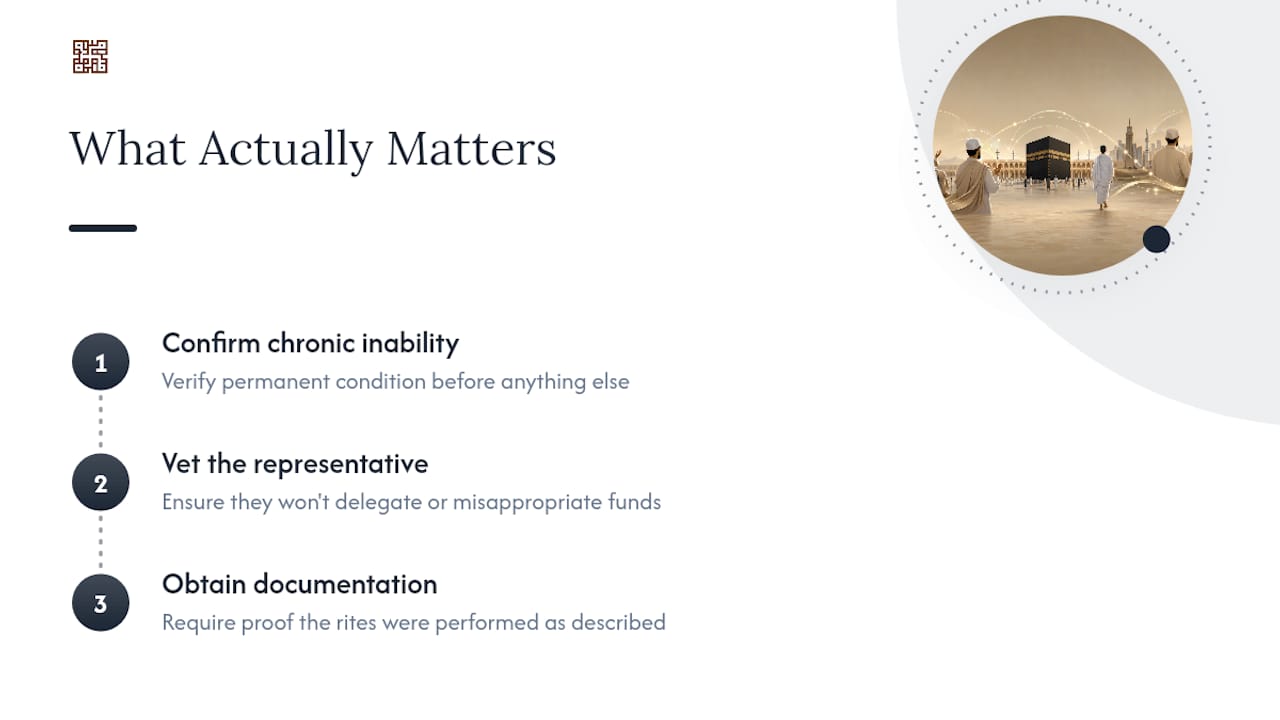
Most people researching this topic spend their energy worrying about whether the ruling itself is strict enough, when the bigger practical risk is a representative who quietly delegates to someone else and pockets the difference. That is where scrutiny should go first.
If you take one thing from this: confirm chronic inability before you confirm anything else, then vet the person performing the rites as carefully as you would vet anyone handling a family member’s affairs. Documentation is not a nice extra. It is the only real evidence you have that the act happened the way it was described. Treat it that way.
— anas
Ready to Arrange a Verified Umrah for a Loved One?
If someone in your family cannot travel due to age or lasting illness, you can find documented alternatives to arranging travel yourself or relying on word-of-mouth arrangements with someone you cannot verify. Packages typically include a completion certificate, photos, and video tied to the person named in the intention, helping ensure clarity about who performed the rites.

Packages range from standard documentation to options that may include live video, letting you choose the level of proof that suits your preferences. Review the full range of Umrah packages to see what documentation each tier includes, or check the FAQ page if you still have questions about eligibility before booking. When you are ready, start with the Badal Umrah landing page to select the package that matches your loved one’s situation.