- umrah gift message ideas
Copy Ready Dua First Umrah Messages for Cards, Tags and Keepsakes
Published on Sep 17, 2026
Copy Ready Dua First Umrah Messages for Cards, Tags and Keepsakes
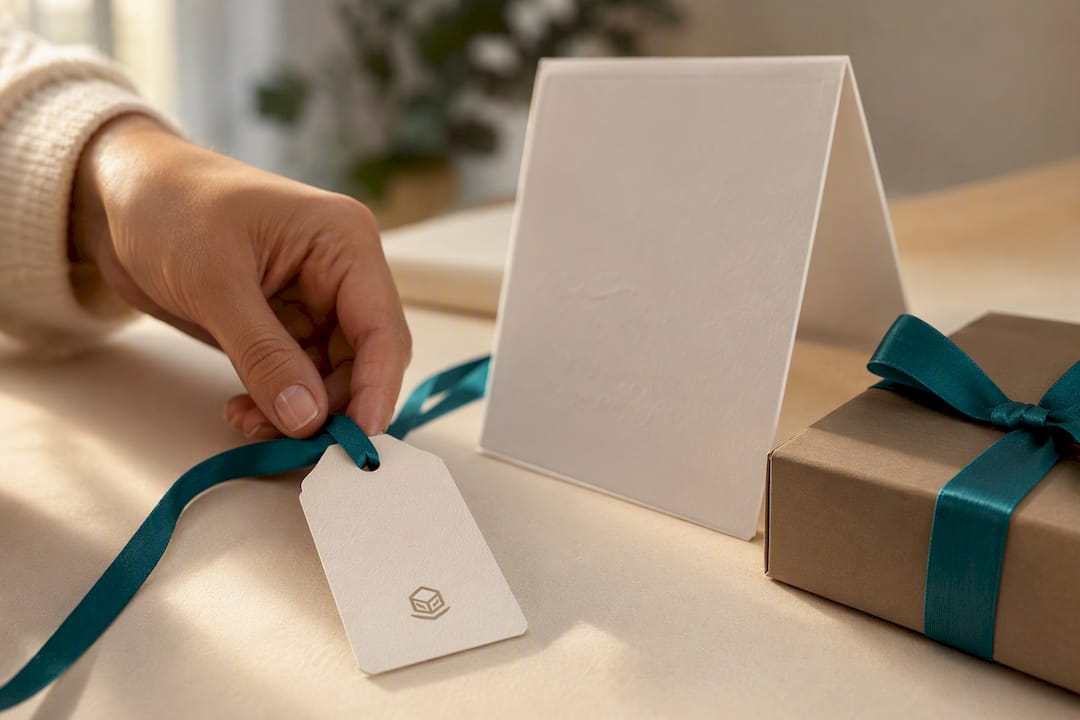
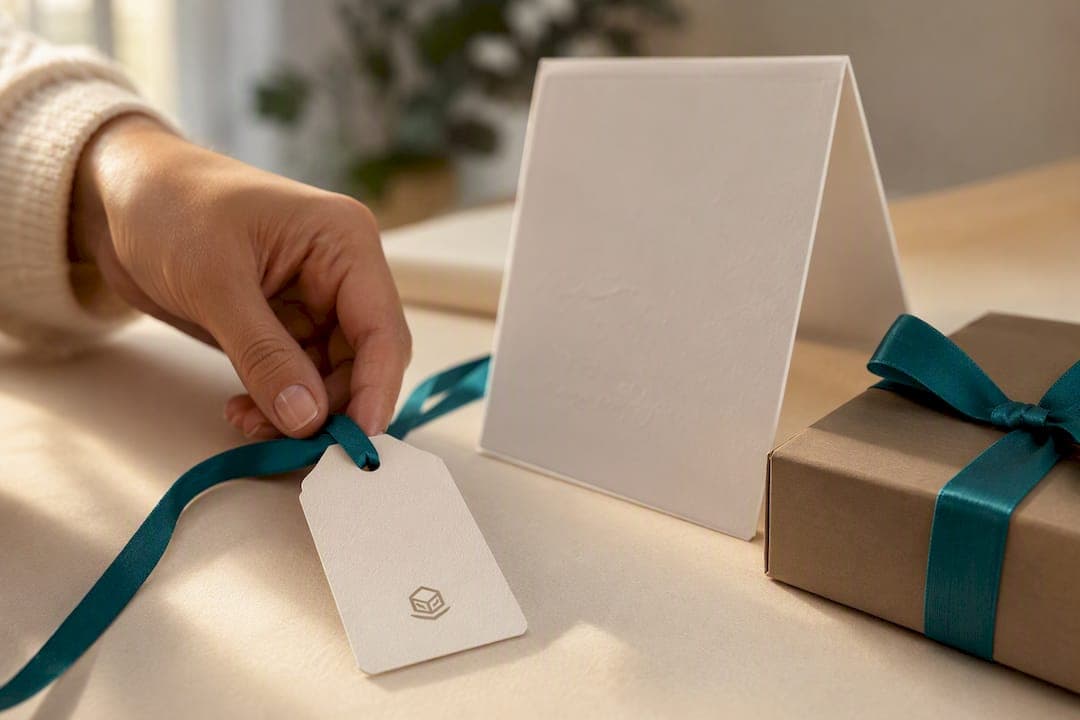
Umrah Mubarak, may Allah accept your worship, purify your heart, and grant you safety on your journey home. Please remember us in your duas. That single line works on a card, a gift tag, or a WhatsApp message with zero editing needed. Dua-focused wording beats generic congratulations because it centers the pilgrim’s spiritual state rather than the trip itself, which lines up with how Islamic gift-giving traditions treat the exchange as an act that increases love between people, not a performance.
TL;DR:
- Short messages should include a blessing and a dua request, focusing on acceptance and forgiveness rather than complimenting the trip.
- Longer heartfelt cards can personalize dua, specific memories, and prayers for the recipient’s health and spiritual reward, especially when printed.
- For physical gifts, pair concise dua phrases with items like Zamzam, dates, or prayer mats, ensuring the message matches the gift’s religious significance.
- Use the same dua formulas repeatedly as they are memorable, humble, and centered on Allah’s acceptance, avoiding elaborate or boastful language.
- Arranging for someone to perform Umrah on another’s behalf is a meaningful spiritual gift, complete with documentation, often more suitable for elders or those unable to travel.
Table of Contents
- Short, Copy-Ready Umrah Gift Message Ideas for Cards and Texts
- Longer Heartfelt Messages and Duas for Printed Cards
- Which Message Fits Which Recipient?
- What to Write on Gift Tags, Certificates, and Keepsakes
- Fill-in-the-Blank Templates for Every Occasion
- Pairing Your Message With the Gift Itself
- Why Dua-Centered Messages Work Better Than Generic Ones
- Writing Umrah Messages for Recipients From Different Backgrounds
- Modern Umrah Gift Messages for Younger Recipients
- When Should You Send an Umrah Gift Message?
- A Word on Keeping It Sincere Over Elaborate
- Consider Umrah on Someone’s Behalf as the Gift Itself
- Sources
- FAQ
Short, Copy-Ready Umrah Gift Message Ideas for Cards and Texts
A short message earns its place on a gift tag when it does two things at once: it names the blessing and it asks for something back, usually a request to be remembered in dua. That two-part structure is what separates a real Umrah message from a generic “congratulations” card. Below are short options grouped by tone, so you can match the wording to the relationship and the medium, whether that’s a WhatsApp caption or a folded card tucked inside a box of dates.
Formal (in-laws, elders, respected colleagues):
- “Umrah Mubarak. May Allah (SWT) accept your Umrah and reward your patience and sincerity.”
- “May your Umrah be accepted, your sins forgiven, and your journey home safe. Ameen.”
- “With respect and love, may Allah grant you the full reward of this sacred journey.”
- “May every step you took in Makkah be written as a good deed. Umrah Mubarak.”
- “A small note to say: may Allah accept your Umrah and grant you a blessed return.”
Warm (close family, siblings, close friends):
- “You’re finally home! May Allah accept every dua you made for us there.”
- “So proud of you. May your Umrah be a means of forgiveness and light.”
- “Welcome back, hajji! Don’t forget you promised to remember me in your duas.”
- “May the barakah of Makkah stay with you long after you’ve unpacked your bags.”
- “Umrah Mubarak, love. May Allah keep you close to Him always.”
Celebratory (friend groups, social captions):
- “Umrah Mubarak to the best traveler I know! May Allah accept it all.”
- “Zamzam, sunburn, and a heart full of gratitude. What a beautiful journey.”
- “She went, she prayed, she came back glowing. Umrah Mubarak!”
- “Officially back from the House of Allah. May it be accepted, ameen.”
- “Umrah Mubarak! May this be the first of many trips to His House.”
Concise dua (when you only have room for one line):
- “May Allah accept your Umrah. Ameen.”
- “Taqabbal Allahu minna wa minkum” (May Allah accept it from us and from you).
- “May your Umrah be a means of mercy and forgiveness.”
- “May Allah grant you Jannah for this journey.”
- “May He accept your sacrifice and grant you ease.”
The etiquette here is simple: keep it humble, keep it dua-first, and skip any language that turns the pilgrimage into a status update. A message that mentions how expensive the trip was, or how “lucky” someone is to have gone, misses the point entirely. The pilgrimage is worship, not a vacation photo op, and the wording should reflect that every time.
Longer Heartfelt Messages and Duas for Printed Cards
A card gives you more room, and more room means you can layer a personal memory, a specific dua, and a direct address to the recipient without it feeling crowded. These work well printed inside a folded card, tucked into a gift box, or written by hand on the back of a photo.
Here are annotated examples you can adapt directly:
- For a parent: “Mom, watching you prepare for this Umrah reminded me why I look up to you. May Allah accept every step, every tear, and every dua you made in front of the Kaaba. May He grant you Jannah and reunite our family there. I love you.” Personalize by naming a specific moment, like the day they left or a phone call from Madinah.
- For a spouse: “My love, you carried our family’s duas with you to the holiest place on earth. May Allah accept your Umrah, forgive your sins, and bless our marriage with more years of worship together. Welcome home.” Swap “marriage” for a shared goal you’re both working toward.
- For a sibling: “You’ve always been the one who prays for everyone else. This time, I hope Allah answered every dua you made for yourself too. Umrah Mubarak, and welcome home.” Add an inside reference only the two of you would recognize.
- For a close friend: “I still remember when you first told me you were saving up for this trip. Seeing it finally happen means so much. May Allah accept your Umrah and keep that closeness to Him with you forever.” Reference the timeline of their planning to make it feel earned.
- For a grandparent: “Your dua has carried this whole family for years. Now it’s our turn to pray for you: may Allah accept your Umrah, ease your body, and grant you long life in His obedience.” Mention their age or health respectfully, without dwelling on it.
- For a colleague or mentor: “Your dedication doesn’t stop at work, it extends to your faith too. May Allah accept your Umrah and reward the example you set for the rest of us.” Keep this one shorter and more formal than the family versions.
- For a child returning with parents: “You’re the youngest hajji I know! May Allah plant the love of His House in your heart from today onward.” Add a small detail, like their age or a toy they brought back.
- For someone who traveled alone: “Doing this journey by yourself takes real courage and trust in Allah. May He have accepted every solitary moment of dua and reflection.” Acknowledge the specific challenge of solo travel rather than generic praise.
- For a widow or widower performing Umrah: “May Allah have accepted this Umrah as a source of comfort and closeness during a hard season. May He grant peace to your heart and reward every tear shed there.” Handle this one gently; avoid mentioning the loss directly unless you know them well.
- For someone who saved for years to go: “This wasn’t a spontaneous trip, it was years of sacrifice and patience. May Allah multiply the reward for every bit of that effort.” Name the specific sacrifice if you know it, like skipping vacations or working extra shifts.
Pro Tip: Write the long version first, then cut it down to a single sentence for the envelope or gift tag. Working from long to short almost always sounds more natural than trying to pad a short line into something longer.
Which Message Fits Which Recipient?
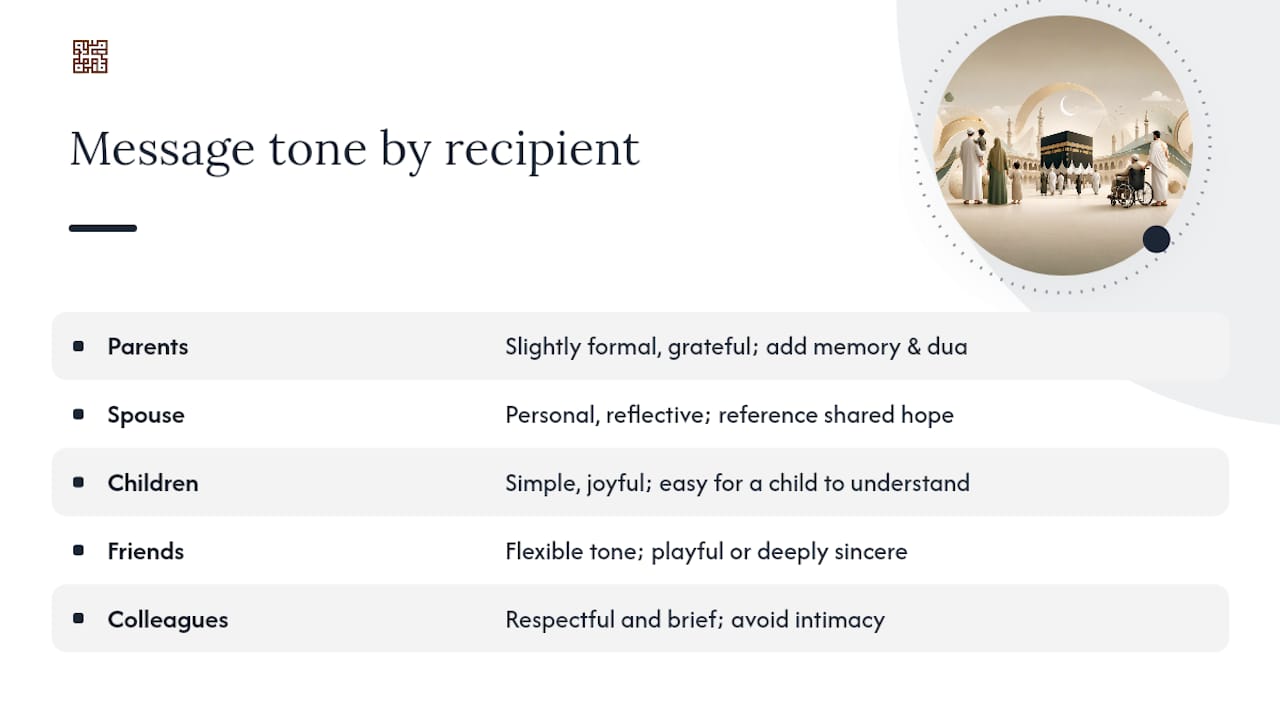
The tone shifts more than the substance when you’re writing for different people in your life. Parents usually expect a slightly more formal register even in a warm message, spouses call for something reflective and personal, and colleagues need something respectful without turning intimate.
For parents: Lean into gratitude and legacy. Short version: “May Allah accept your Umrah and reward your years of raising us in faith.” Long version: add a memory of them teaching you to pray or fast, then close with a dua for their health and Jannah. Template: “[Name], watching you leave for Umrah reminded me of [specific memory]. May Allah accept every dua you made there, especially for our family.”
For a spouse: This is where you can be the most personal and reflective. Short version: “You carried our home’s hopes to the Kaaba. Welcome back, my love.” Long version: reference a shared goal, a prayer you made together before they left, or how the relationship changed while they were gone. Template: “[Name], while you were in Makkah I kept thinking about [shared memory or hope]. May Allah accept your Umrah and bless the life we’re building together.”
For children: Keep it simple, joyful, and easy for a child to understand. Short version: “You’re a hajji now! May Allah always keep your heart close to His House.” Template: “[Name], you did something so special by going to Makkah. May Allah keep that love in your heart forever.”
For friends: This is the most flexible category, ranging from playful to deeply sincere depending on how close you are. Short version: “Umrah Mubarak! Don’t forget to tell me everything.” Template: “[Name], I’ve been thinking of you this whole trip. May Allah have accepted every dua, and I can’t wait to hear about it.”
For colleagues: Stay respectful and brief; this isn’t the place for inside jokes or overly personal reflection. Short version: “Umrah Mubarak. May your journey be accepted and your return be blessed.” Template: “[Name], congratulations on completing your Umrah. May Allah reward your dedication to your faith.”
What to Write on Gift Tags, Certificates, and Keepsakes
Space runs out fast on a tag or an engraved plaque, so the wording has to do more with less. The formula that works best: name plus a short dua plus a date, in that order, trimmed to whatever fits the item.
- “[Name] — Umrah 2026. May Allah accept it. Ameen.”
- “For [Name], on the completion of your Umrah. Taqabbal Allah.”
- “[Name]'s Umrah Journey — [Hijri date] / [Gregorian date].”
- “May this Umrah be accepted and remembered. [Name], [year].”
- “A journey to the House of Allah. [Name], Umrah [year].”
- “Umrah Mubarak, [Name]. May it be a means of mercy.”
- “In memory of [Name]'s Umrah — may Allah accept every step.”
- “[Name] — first Umrah, [Hijri date]. May Allah accept and bless.”
- “Presented to [Name] for completing Umrah with sincerity and love.”
- “Umrah Mubarak. May Allah grant [Name] Jannah for this journey.”
On the date question, using both the Hijri and Gregorian dates is common practice on engraved keepsakes, since it makes the piece meaningful whether the recipient references the Islamic calendar or not. If the recipient has strong ties to Arabic script and the item has room, adding their name in Arabic alongside the English version gives the keepsake more weight without adding much length.
Pro Tip: For engraving, count characters before you commit. “Taqabbal Allah minna wa minkum” reads beautifully on a card but eats the entire surface of a small tasbeeh box. Swap it for “May Allah accept it” when space is tight, and save the fuller Arabic phrase for a card that goes with the gift.
Fill-in-the-Blank Templates for Every Occasion
Different moments call for different message structures. Use these as starting frames, then swap in names, dates, and specific details.
Pre-departure templates (before they leave):
- “[Name], safe travels to the House of Allah. Please carry my dua for [specific request].”
- “May Allah ease your journey to Makkah and accept everything you set out to do.”
- “Going to see the Kaaba! May Allah protect [Name] every step of the way.”
During-pilgrimage templates (sent while they’re there):
- “Thinking of you at the Haram, [Name]. Please remember [family/name] in your duas.”
- “May Allah accept your tawaf, your prayers, and every tear shed there today.”
Welcome-home templates (upon return):
- “Welcome home, hajji! May Allah have accepted every part of your Umrah.”
- “[Name] is back and glowing with barakah. May Allah accept it all, ameen.”
- “So happy you’re home safe. Did you remember to pray for the rest of us?”
Congratulatory / general templates:
- “Umrah Mubarak, [Name]! May Allah accept your worship and grant you peace.”
- “Congratulations on completing your Umrah. May it be a means of forgiveness.”
- “[Name], may this journey be the first of many to His House.”
For social captions and WhatsApp status updates, keep it to one line and lead with the dua rather than the description of the trip:
- “Umrah Mubarak 🤍 May Allah accept it.”
- “Home from the House of Allah. Alhamdulillah for everything.”
- “May every dua made in Makkah be answered. Ameen.”
Arabic phrases like “Taqabbal Allahu minna wa minkum” work well when the recipient recognizes and appreciates the phrase; if you’re not sure they’ll understand it, pair it with the English translation or skip it in favor of plain English. Save the longer Arabic duas for printed cards where there’s room to include both the phrase and its meaning.
Pairing Your Message With the Gift Itself
The wording should echo what the object represents. A bottle of Zamzam calls for a message about purity and blessing; a prayer mat calls for a message about ongoing worship. Matching the two makes the whole gift feel considered instead of grabbed off a shelf.
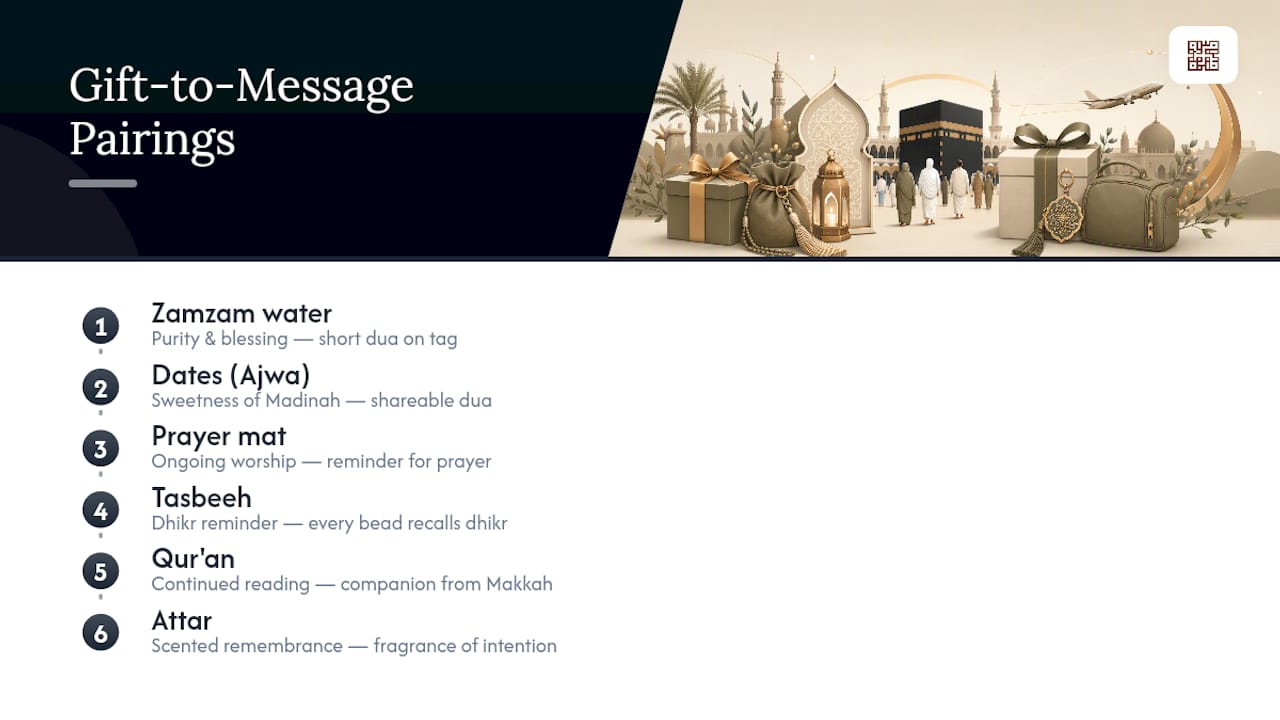
Zamzam water: “May this water carry the same barakah you felt drinking it in Makkah.” / “A sip of Zamzam, a lifetime of blessing. May Allah accept your Umrah.” Zamzam and Ajwa dates from Madinah are among the most requested Umrah gift items, largely because they’re small, shareable, and carry direct religious significance.
Dates (especially Ajwa): “Sharing the sweetness you brought back from Madinah. May Allah accept your Umrah.” / “A small taste of Madinah, a big dua for your acceptance.”
Prayer mat: “May this mat carry the same sincerity you showed at the Haram.” / “For every prayer ahead, may this mat remind you of the one you stood on in Makkah.”
Tasbeeh: “May every bead remind you of the dhikr you made there.” / “A small tool for a big habit. May Allah accept your Umrah.”
Qur’an: “May this Qur’an be a companion as close as the one you held in Makkah.” / “For the reading you started there, may it continue here.”
Attar (Islamic perfume): “A scent to remember the journey by. May Allah accept your Umrah.” / “May this fragrance carry the same purity of intention you had there.”
When you’re combining two or three items in one box, put the shortest, most concise dua on the outer tag and save the longer message for a card tucked inside. During Ramadan specifically, pairing a short dua with something celebratory like flowers or sweets alongside the religious item tends to land especially well, since the season already carries an emotional weight that a plain gift box doesn’t capture on its own.
Why Dua-Centered Messages Work Better Than Generic Ones
Islamic gift-giving has never been about the object alone. Gifting exists partly to increase love between people, which means the message attached to a gift carries as much weight as the item itself. A dua-centered message does something a generic “congrats” card can’t: it asks Allah to accept the pilgrim’s worship, which is the actual point of the trip, rather than complimenting the trip as an experience.
“May Allah accept it from us and from you” is one of the most repeated phrases across Umrah wishes, precisely because it does two things at once: it honors the pilgrim’s effort and asks for something spiritual in return, not a compliment about the journey itself.
This is also why so many collections of Umrah Mubarak wishes lean on the same handful of dua formulas rather than inventing new phrasing each time. There’s a reason it works: the phrases are short, they’re memorable, and they put the focus where it belongs, on acceptance, forgiveness, and safety, rather than on how nice the trip looked.
Some services offer a way for people who cannot travel themselves, whether due to illness, old age, or the death of a loved one, to have Umrah performed on their behalf by a trusted representative. Bookings often come with documentation, including certificates, photos, and video, to assure families that the pilgrimage was carried out with care. Some portions of proceeds may also support charitable relief efforts, aligning with the charitable spirit of Islamic gift-giving, even when the gift is a spiritual act rather than a physical object.
Writing Umrah Messages for Recipients From Different Backgrounds
Not every recipient shares the same cultural or linguistic background, even within the same Muslim community. Someone raised in an Arabic-speaking household might expect a phrase like “Taqabbal Allahu minna wa minkum” without translation. Someone newer to the faith, or from a non-Arabic-speaking background, will connect more with the English meaning spelled out plainly: “May Allah accept it from us and from you.”
A practical rule: if you’re unsure whether the recipient understands Arabic religious phrases, include both. Write the Arabic phrase, then the English translation in parentheses right next to it. This works especially well on cards and certificates, where there’s enough space for both without feeling cluttered.
For recipients with South Asian backgrounds, phrases like “Umrah Mubarak” (rather than just “Congratulations”) are already widely understood and expected. For converts or reverts to Islam, a slightly more explanatory message, one that briefly notes what the dua means, shows thoughtfulness without sounding like a lecture. For recipients from West African or Southeast Asian Muslim communities, sticking to universally recognized phrases like “Umrah Mubarak” and “May Allah accept it” travels well across nearly every cultural context, since these have become standard across the wider Muslim world regardless of first language.
The safest approach across any background: lead with the dua in whatever language feels most natural to you, then add the English meaning if there’s any doubt the recipient will follow it.
Modern Umrah Gift Messages for Younger Recipients
Younger recipients and close friends often want something that still centers the dua but doesn’t read like it was copied from a religious pamphlet. The trick is keeping the sincerity while loosening the formality.
A few examples that land well with a younger crowd:
- “Umrah Mubarak, bestie 🤍 May Allah accept every dua you made for both of us.”
- “Officially the most glowed-up person in the group chat. May Allah accept your Umrah!”
- “You went and did the thing. May Allah accept it and may we both make it back one day.”
- “Can’t believe you’re back already. May Allah accept every step and every tear.”
- “Umrah Mubarak! Now come tell me everything over coffee.”
These work because they keep the actual dua (acceptance, mercy, reward) fully intact while dropping the stiffness that can make religious messages feel distant to younger readers. A short emoji, a casual opener, or a reference to an inside joke doesn’t cheapen the sentiment as long as the dua itself stays clear and sincere. What doesn’t work: turning the whole message into a joke with no dua at all, or making the trip about aesthetics (“your pictures were amazing!”) instead of the spiritual weight of what actually happened.
When Should You Send an Umrah Gift Message?
Timing changes the tone more than people expect. A pre-departure message should focus on safety and ease, since the person hasn’t done the spiritual work yet. Something like “May Allah ease your journey and accept everything you set out to do” fits better here than a message about acceptance, which technically hasn’t happened yet.
During the pilgrimage itself, short messages sent by text work best, mostly because the person is busy and won’t read anything long. A single line like “Thinking of you at the Haram, please remember us in your dua” respects their time and their focus.
The most common moment for a full message, card, or gift is after the person returns home. This is when “may Allah accept your Umrah” actually makes sense grammatically and spiritually, since the act is complete and the dua is asking Allah to accept something that already happened. This is also when longer cards, keepsakes, and gift pairings make the most sense, since the recipient has time to sit with the message rather than glancing at a phone screen between rituals.
If you’re gifting something physical, like Zamzam or a prayer mat, presenting it within the first few days of their return tends to land better than waiting weeks, while the experience is still fresh and the sentiment still feels timely.
A Word on Keeping It Sincere Over Elaborate
The biggest mistake people make with Umrah gift messages isn’t picking the wrong words, it’s overthinking the presentation. A short, sincere dua on a plain card will always mean more than an elaborate message that reads like it was written to impress rather than to bless. The pilgrimage itself is an act of humility, and the message that accompanies a gift should carry that same spirit rather than compete with it.
What I’d push back on is the growing trend of treating Umrah return gifts like a full event, matching decor, professional photos, elaborate hampers. None of that is wrong, but none of it replaces the actual point of the message: asking Allah to accept the person’s worship. If you only have room for one sentence, make it a dua, not a description of how proud you are or how nice the trip looked in photos.
— anas
Consider Umrah on Someone’s Behalf as the Gift Itself
Every message above assumes the recipient already went on their own Umrah. But there’s another gift entirely worth considering: arranging for Umrah to be performed on behalf of someone who can’t travel themselves, whether that’s an aging parent, a relative with health limitations, or a loved one who has passed away. This is a fundamentally different category of gift from a prayer mat or a bottle of attar. Instead of a physical object, the giver commissions a trusted representative to carry out the pilgrimage rituals in that person’s name, and the family receives documentation proving it happened.
Packages can include a certificate, photos, and video of the completed Umrah to provide evidence the gesture was carried out. This matters most for families honoring a deceased relative or supporting an elder who is physically unable to travel, since a Badal Umrah gives them the spiritual credit of the pilgrimage without requiring them to make the journey.
A few pages worth checking if you’re considering this route:
- The Badal Umrah Barakah Premium package outlines what’s included at the higher tier, including live features and full video documentation.
- The FAQ page covers religious compliance questions and how the process works from booking to certificate delivery.
- The Umrah packages collection lists the different tiers available if you’re comparing options before choosing one.
This is worth stating plainly: a Badal Umrah is not a replacement for a physical gift, and it’s not competing with a bottle of Zamzam or a nice prayer mat. It’s an alternative class of gift entirely, one built around a spiritual act rather than an object, and it fits best for anyone who’s ever wished they could give a loved one the reward of a pilgrimage they physically cannot make. If that’s the kind of gift you’re weighing, the Badal Umrah homepage walks through how the service works from start to finish.
Sources
- FNP Saudi Arabia Gifts for Umrah
- Saudipedia Gifts in Saudi Arabia
- Floward Ramadan Umrah gifts: Thoughtful ideas to welcome loved ones
FAQ
What should you gift someone who completed Umrah?
Practical, spiritually meaningful items work best: Zamzam water, dates from Madinah, a prayer mat, tasbeeh, a Qur’an, or attar, paired with a short dua-centered card rather than a generic congratulations note.
How do you wish someone a happy Umrah?
Say “Umrah Mubarak” alongside a short dua, such as “May Allah accept your Umrah and grant you a safe return,” rather than a plain “congratulations,” since the phrase centers the spiritual purpose of the trip.
What are good Umrah Mubarak gift ideas?
Zamzam water, Ajwa dates, a prayer mat, tasbeeh, and personalized keepsakes are among the most common choices, especially when paired with a card that includes a brief acceptance dua.
How do you congratulate someone who just returned from Umrah?
Lead with a dua for acceptance, something like “May Allah accept your Umrah and forgive your sins,” then add a personal line referencing your relationship, whether that’s a shared memory or a request to be remembered in their duas.
Is arranging a Badal Umrah an appropriate gift?
Yes. It works especially well for family members who cannot travel due to age, illness, or death, and Badalumrah provides a certificate along with photos and video as proof the pilgrimage was completed on their behalf.