- wasiyyah for badal umrah
Wasiyyah for Badal Umrah: How to Leave and Fulfill One
Published on Nov 26, 2026
Wasiyyah for Badal Umrah: How to Leave and Fulfill One
A wasiyyah for Badal Umrah is a bequest in which you ask, before you die, that someone perform Umrah in your name and that the cost be paid from your estate. It is valid under the ruling of at least one major school, it is capped at one-third of the estate unless the heirs agree to more, and it comes after debts and any obligatory Hajj or Umrah you left undone. If you are the family carrying out such a will, we perform the Umrah for you, with photos, video and a certificate as proof, from $150.
TL;DR
- A wasiyyah is a will or bequest: instructions that take effect after death. Asking for a Badal (substitute) Umrah is one such instruction.
- A voluntary Umrah bequest is generally limited to one-third of the estate. More than that needs the heirs’ approval after the death.
- Debts and obligatory dues, including an unperformed obligatory Hajj or Umrah, come before a voluntary bequest.
- The person who performs it should already have done their own Umrah. State the intention clearly in writing so the family is not left guessing.
- Our packages run from $150 to $500 as a one-time fee, so most bequests fit well within the one-third.
Table of Contents
- What a wasiyyah for Badal Umrah means
- Is it valid to ask for Umrah in your will?
- Obligatory first, voluntary second
- The one-third limit, with a worked example
- How to write the wasiyyah
- Who carries out the wasiyyah
- Conditions for the person who performs it
- How the Umrah is performed for the deceased
- When the schools differ
- Carrying out the bequest with Badal Umrah
- Fulfilling your parent’s or relative’s wishes
- Our perspective
- Book a Badal Umrah for a wasiyyah
- FAQ
- Sources
What a wasiyyah for Badal Umrah means
Wasiyyah (also spelled wasiyya) is the Arabic word for an Islamic will or bequest. One widely used English edition of Ayatollah Sistani’s rulings on wills defines it as instructions for after death about money, property, children or entrusted tasks, and religious acts are included among those tasks.
Badal means substitute. Badal Umrah is Umrah performed by one person on behalf of another. Put together, a wasiyyah for Badal Umrah is a person saying: after I die, let someone perform Umrah for me, and pay for it from what I leave.
This is different from a family simply deciding, after a death, to send an Umrah for their father or mother. That is also a good and common act, and we cover it below. The wasiyyah matters because it turns your wish into an instruction the family and executor can follow, and it gives the cost a clear place in the estate.
Is it valid to ask for Umrah in your will?
Scholars of the major schools have addressed this, and the answer is yes within defined limits. Malaysia’s Federal Territories Mufti Department, in Fatwa Series 653 of 29 November 2021, states that under the relied-upon Shafi’i position it is valid to make a wasiyyah for a voluntary proxy Hajj or Umrah to be done after death.
The International Fatwa Authority also treats the will as the thing that makes a voluntary Umrah for the deceased proper. Its ruling on Umrah without a will distinguishes between an obligatory Umrah left owing, which is due from the estate, and a voluntary one, which it ties to the deceased having bequeathed it.
In practice this means a written wish gives your family firm ground. Without it, a relative can still perform Umrah for you out of love, and scholars have addressed that too, but the will removes doubt.
Obligatory first, voluntary second
This is the point families most often get wrong, so it is worth slowing down.
If the deceased had Hajj or Umrah become obligatory on them, meaning they had the means and ability, and never discharged it, that duty is treated as a debt to Allah. The same Malaysian ruling says an obligatory Hajj or Umrah must be prioritized over a voluntary bequest.
The Sistani-based will guidance describes the same order from the Jafari side: debts and obligatory religious dues are deducted first, and only then is the one-third available for discretionary bequests calculated. A voluntary Umrah request does not displace creditors or mandatory obligations.
So the sequence for an estate looks like this:
- Funeral costs and debts. Funeral costs are one of the first claims on an estate, and this guide to paying funeral costs from the estate shows how that works in Australia. Rules differ by country.
- Any obligatory Hajj or Umrah the deceased left undone.
- The voluntary bequests in the will, including Badal Umrah, within one-third.
- The remainder to the heirs.
If you are unsure whether Umrah had become obligatory on your loved one, ask a qualified imam in your own school before the estate is divided. That one question changes the order of payment.
The one-third limit, with a worked example
The general bequest rule is that a will may dispose of no more than one-third of the estate without the heirs’ consent. A peer-reviewed study of will-making in Islam describes this rule and adds that anything beyond one-third may still be carried out if the heirs consent after the testator’s death. The Malaysian ruling adds a practical point: a voluntary proxy-pilgrimage bequest is void if one-third cannot cover it.
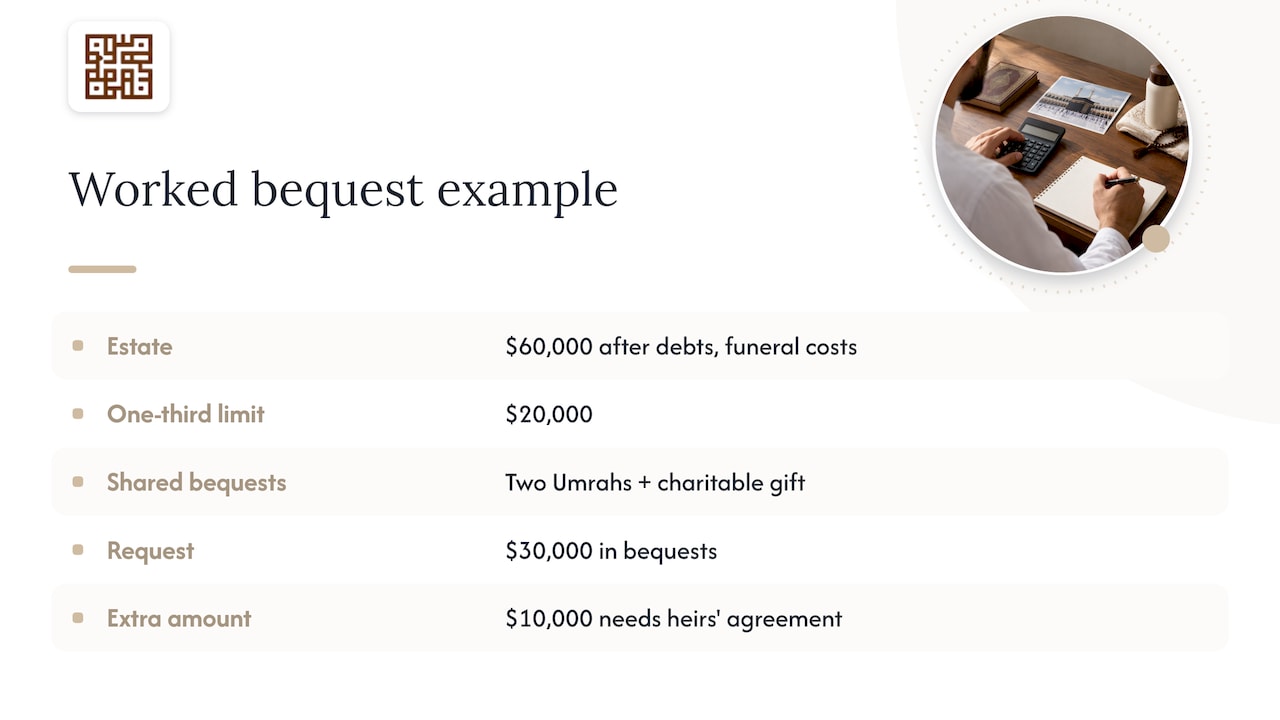
A simple example. Suppose a father leaves an estate worth $60,000 after debts and funeral costs. One-third is $20,000. His will asks for two voluntary Umrahs and a charitable gift. All three come out of that $20,000 together. If he had asked for $30,000 in bequests, the extra $10,000 would need his heirs’ agreement.
Because a Badal Umrah is not a large sum, the limit seldom bites. It matters most in modest estates and in wills with many bequests. Our Barakah Package, for example, is $400 as a one-time fee, and the Jariyah Premium Package is $500. Write the amount you intend in your will, or name a range, so the executor can act without negotiating.
How to write the wasiyyah
The same academic study notes that jurists disagree about the formal pillars of a will, and that a written or spoken bequest can be valid when the testator’s intention is clear. It also describes witness requirements in the classical accounts. The safest course follows from that: be unmistakable, and make it written and witnessed.
A useful wasiyyah for Badal Umrah states:
- Who it is for. Your own full name, and whether it covers one Umrah or several.
- The type. Voluntary Umrah, or an obligatory one you left owing, if applicable.
- The funding. That the cost is paid from your estate, with a maximum amount, within one-third.
- Who carries it out. Name your executor, and a fallback such as a named child.
- The proof you want. For example, photos, video and a certificate returned to the family.
- Your school or jurisdiction, if you follow a specific one.
Then have it drawn up under the law where you live. Islamic bequests and civil wills do not always line up, and the civil will is what a court or bank will act on. A lawyer who drafts wills in your country, together with your imam, can make sure both agree. We are not a law firm, and a will is a legal document, so this is where a professional belongs.
Who carries out the wasiyyah
The International Fatwa Authority’s ruling on Umrah for a deceased person sets out the responsibility. If the deceased left no estate, a relative may perform the obligatory Umrah for them. If there is estate property, the duty falls to the executor first, then to an heir, and then to the authority if the earlier parties do not act.
For a family, that means a named executor should not leave the Umrah sitting. Many executors are busy with property, accounts and paperwork, and a pilgrimage across the world is not simple to arrange. Booking a Badal Umrah service closes that item in one step, with a fixed price you can record in the estate accounts.
Conditions for the person who performs it
Whoever performs the Umrah must meet conditions. Jordan’s General Iftaa’ Department states that the proxy should already have performed Hajj and Umrah for themselves. We cover this in more detail in our guide to who qualifies as a proxy, and the related question of proxy before your own Hajj.
The same Iftaa’ ruling covers the living. Proxy Umrah for a living person is permitted when illness is not expected to resolve or old age prevents performing it, and the living person’s permission is required. So if you are elderly or ill, you do not have to wait for a will. You can authorize it yourself now, and our guide to Badal Umrah for an elderly parent walks through that case.
How the Umrah is performed for the deceased
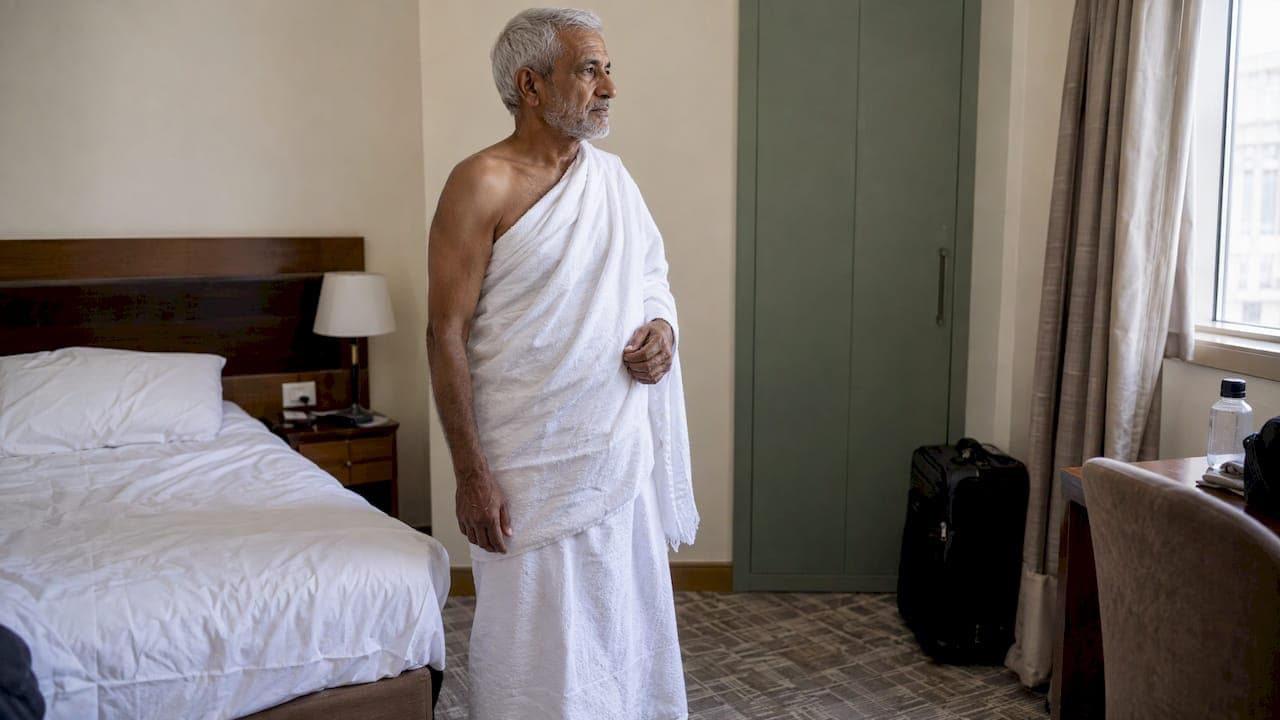
The proxy makes the intention for the named person at the miqat, the boundary where pilgrims enter ihram, and then completes the rites: tawaf, sa’i, and the shaving or trimming of the hair. The intention names the person by name. Our guide to the miqat for Badal Umrah explains where the proxy enters ihram, and if you are ordering several Umrahs, separate intentions for each person matter.
The reward is a matter of Allah’s acceptance. The Permanent Committee for Scholarly Research and Ifta, in Fatwa 18808, permits a person who has done their own Umrah to perform one for a deceased Muslim, and says the reward reaches the deceased if Allah accepts it. That is the right spirit for a family: do it with sincerity, and leave acceptance to Allah.
When the schools differ
Scholars do not all give identical answers on voluntary proxy pilgrimage, and the study of will-making warns that testamentary rules are detailed. For a family that means one thing: follow the position of your own school and ask your imam when the will is unclear. Write the clear intent down, and do it while you are able.
We perform every Umrah in accordance with Islamic law, verified by qualified imams. Our Saudi fatwas and eligibility guide sets out the rulings we work from.
Carrying out the bequest with Badal Umrah
Once the estate is ready, the family’s job is to make the Umrah happen and keep a record. Here is a straightforward routine:
- Confirm the amount available within the one-third and that debts and obligatory dues are settled.
- Decide how many Umrahs the will asks for and for whom.
- Choose a package. Each is a one-time fee with no recurring charges.
- Give the full name of the person the Umrah is for.
- Receive the proof: photos, video and a certificate. Keep it with the estate papers.
The packages are:
| Package | Price (one-time) |
|---|---|
| Du’a Package | $150 |
| Noor Package | $250 |
| Barakah Package | $400 |
| Jariyah Premium Package | $500 |
The packages differ in speed and features. If the will also asks for Hajj, we offer Hajj Badal, Ifraad at $1,500 and Hajj Badal, Tamattu’ with Umrah and Qurbani at $2,500.
Fulfilling your parent’s or relative’s wishes
Sometimes a person never wrote a wasiyyah but spoke of it. A Hanafi answer collected by IslamQA says heirs are not responsible to arrange a proxy pilgrimage when the deceased neither instructed it nor left sufficient means, but that a willing heir’s performance can still be acceptable. Families who want to honor a parent in that way can do so with a clear heart, using their own funds, and the same booking steps apply.
Our perspective
We hear from many families at the moment they want to do something for someone they love and do not know where to begin. A wasiyyah gives that wish a form. Put it in writing, keep it within the one-third, settle debts and obligatory duties first, and name the person who will carry it out.
Then let the Umrah itself be simple. We perform Umrah strictly in accordance with Islamic law, verified by qualified imams, with documentation, real-time updates and compassionate support. A fixed one-time fee, from $150, means the executor can record the cost before anything is done, and the family receives photos, video and a certificate to keep.
For you. For your loved ones. For their forgiveness.
anas
Book a Badal Umrah for a wasiyyah
If you are carrying out a bequest, or writing one and want to know what it will cost, our packages start at $150 and each is a one-time fee. Each comes with photos, video and a certificate, so the family has a record for the estate file.

See the Du’a Package or visit Badal Umrah to choose the package that fits the wishes in the will.
FAQ
Can I ask for Umrah to be performed for me in my will?
Yes. The Federal Territories Mufti Department of Malaysia holds that a wasiyyah for a voluntary proxy Umrah is valid under the relied-upon Shafi’i position. Write who it is for, how it is funded, and who carries it out, and have the will drawn up under your local law.
How much of the estate can the bequest use?
A voluntary bequest is generally limited to one-third of the estate, after debts and obligatory dues. The heirs may approve more after your death. Since a Badal Umrah package costs from $150 to $500 with us, it usually sits well inside that limit.
What if the deceased owed an obligatory Umrah?
The obligatory Umrah comes first and is paid from the estate before any voluntary bequest. If there is no estate, a relative may perform it. Ask a qualified imam in your school whether it had become obligatory.
Does the proxy need to have done Umrah first?
Yes. The Jordanian Iftaa’ Department requires the proxy to have already performed Hajj and Umrah for themselves. For a living person who cannot travel, their permission is also required.
Sources
- Malaysia Federal Territories Mufti Department, Fatwa Series 653
- Islamic Laws of the Will, IMAM-US
- International Fatwa Authority, Umrah without a will
- International Fatwa Authority, Umrah for the deceased
- Will-making (Wasiyyah) in Islam: A Juristic Exposition, Shariah Journal
- Jordan Iftaa’ Department, delegating Umrah
- Permanent Committee, Fatwa 18808
- Paying for a funeral from the estate