- choose umrah representative
- umrah proxy name
- qualified umrah representative
- appoint umrah proxy online
- umrah representative screening
- trusted umrah proxy
- how to pick umrah agent
- choosing an umrah provider
- select umrah agent
- best umrah services
3 Screening Steps to Choose an Umrah Representative Before You Pay
Published on Sep 18, 2026
3 Screening Steps to Choose an Umrah Representative Before You Pay

Choose a wakil, or a documented Badal Umrah service, that meets two non-negotiable conditions: the performer has already completed their own Umrah, and they will declare the intention (niyyah) naming your beneficiary at Miqat, before entering Ihram. Beyond that, insist on verifiable proof, a certificate, photos, or video, before you hand over payment. Services like Badalumrah publish exactly this kind of documentation as a standard practice, which gives you a working example of what “verifiable” should actually look like.
TL;DR:
- Services must have their own Umrah completed and declare the beneficiary’s niyyah at Miqat before entering Ihram to be considered legitimate.
- The performer must be a Muslim adult who has already performed their own Umrah; a representative who has not done so cannot validly perform Badal Umrah.
- Confirm the provider’s documentation practices by requesting signed certificates, media evidence, and a clear, written wakala agreement before payment.
- After completion, expect a certificate, timestamped photos, and possibly videos or live verification, with timely delivery being a key indicator of reliability.
- Avoid providers who cannot deliver proof, refuse to sign agreements, or lack transparency about the performer’s identity, as these raise red flags for potential scams.
Table of Contents
- Who Qualifies for Umrah Badal, and What Rules Apply?
- How Do You Screen a Wakil or Badal Service Before Paying?
- What Exact Questions Should You Ask a Provider?
- What Proof Should You Expect After Umrah Is Completed?
- What Documentation Practices Separate a Legitimate Provider From a Risky One?
- Why Most Advice on This Topic Undersells the Contract Step
- Ready to Book a Documented Badal Umrah?
- Where to Verify These Rules Yourself
- Sources
- FAQ
Who Qualifies for Umrah Badal, and What Rules Apply?
Badal Umrah exists for two groups: people who have died and people who are permanently unable to travel, whether from advanced age, chronic illness, or disability. A cold, a broken leg that will heal, or a temporary visa delay does not qualify. If recovery or travel is realistically possible later, the obligation stays with the person, not a substitute.
The person performing the Umrah on someone else’s behalf has to meet a specific bar. They must be a Muslim adult of sound mind, and critically, they must have already performed their own Umrah before doing one for someone else. A representative who has never completed their own pilgrimage cannot validly stand in for another person, no matter how sincere the intention.
Timing matters as much as eligibility. The niyyah naming the specific beneficiary needs to happen before entering Ihram, at Miqat, not sometime during the rituals. A simple formulation works: “Allahumma inn Urdu al-Umrata an [name], fa-yassirha li wa taqabbalha minhu/minha” (“O Allah, I intend to perform Umrah on behalf of [name]; make it easy for me and accept it from him/her”).
A few rules trip people up:
- If the person is alive, you need their explicit permission before arranging Badal on their behalf.
- For someone deceased, permission from the heirs is the standard.
- One Umrah covers exactly one person. A representative cannot combine two or more beneficiaries into a single performance; each person needs their own complete ritual.
Skipping any of these steps doesn’t just create a paperwork problem. It can invalidate the entire Badal, leaving the family believing an obligation was fulfilled when it wasn’t.
How Do You Screen a Wakil or Badal Service Before Paying?
Treat this like hiring anyone else to handle something you can’t personally verify: ask direct questions, get answers in writing, and walk away from vague responses.
- Confirm the performer’s own Umrah history first. Ask outright whether the person completing the ritual has performed their own Umrah, and whether they’re acting as your appointed wakil under a signed agreement. Legitimate providers commonly formalize this with a power of attorney or wakala document that names the representative and the task.
- Get the procedural details in writing. Where and when does the niyyah get declared? Who actually performs each ritual step, Tawaf, Sa’i, the rest? How many days does the whole process take, and is there any third-party witness involved?
- Check the money and identity details. Ask for a clear fee breakdown, the refund policy in plain terms, and confirmation of who, specifically, will be performing the pilgrimage. A provider that won’t name the performer is a provider you should skip.
Pro Tip: Call or message before you book, not after. A legitimate wakil or service answers procedural questions without hesitation; a scam operation gets vague or defensive the moment you ask for specifics.
Watch for red flags that show up again and again in complaints: no named performer, no willingness to share a sample certificate or past proof, refund terms that sound generous on a landing page but fall apart under questioning, and any refusal to sign even a basic wakala agreement. None of these are dealbreakers in isolation, but two or more together should end the conversation.
What Exact Questions Should You Ask a Provider?
Before you send payment, get answers to these on the phone or in a message thread you can reference later.
- Has the performer completed their own Umrah, and will they declare the niyyah specifically for [beneficiary’s name]?
- Can you provide a sample certificate, and what’s your policy on photo or video proof, including live verification for premium packages?
- Will you sign a written wakala or agreement, and what’s the full pricing breakdown, expected timeline for proof delivery, and refund process if something goes wrong?
- How do you document that this Umrah was performed for one named person only, consistent with the one-Umrah-per-person rule?
If a provider dodges any of these or gives you a generic brochure answer instead of specifics, that’s your signal to look elsewhere. A trustworthy umrah representative treats these questions as routine, because they answer them for every family that asks.
What Proof Should You Expect After Umrah Is Completed?
A completed Badal Umrah should come with more than a text message saying “it’s done.” Reputable providers typically supply a signed certificate naming the beneficiary, along with timestamped photos near the Kaaba during Tawaf and short video clips. Some premium packages now offer live-stream verification, letting a family watch key moments as they happen rather than waiting days for edited footage.
To verify what you receive:
- Check photo and video metadata for timestamps that match the claimed performance dates.
- Ask for more than one form of media. A single blurry photo isn’t proof; a certificate plus photos plus a short clip is.
- Request witness or third-party confirmation if the package or price point supports it.
Most services deliver certificates and media within a set window after the Umrah is performed, though exact timing varies by package tier and provider workload. If proof doesn’t arrive, contact the provider immediately, reference your signed wakala or agreement, and request a refund or mediation if they stall. Community scholars can also weigh in on disputed cases.
One recurring pattern worth flagging: the combination of a signed wakala agreement plus at least two independent media forms, photo and video together, gives families a stronger evidence trail than either one alone, and it’s a model worth insisting on regardless of which provider you choose.
What Documentation Practices Separate a Legitimate Provider From a Risky One?
Publishing rulings openly is one of the clearer signals of a serious operation. When a provider lays out the religious basis for Badal Umrah rather than just advertising the service, it signals they expect informed customers, not just paying ones. Badalumrah does this, alongside procedural transparency about how niyyah is handled, and documentation, certificates, photos, video, with optional live verification for higher package tiers.
Some providers include a charitable commitment as part of their service rather than a marketing afterthought. That’s a concrete, checkable claim rather than a vague promise, and it’s the kind of detail worth looking for when you’re comparing providers.
Why Most Advice on This Topic Undersells the Contract Step
Most guidance on choosing a Badal Umrah representative focuses almost entirely on the religious conditions, and rightly so, since getting the niyyah and eligibility wrong invalidates everything else. But the practical failure point isn’t usually theology. It’s the absence of a paper trail.
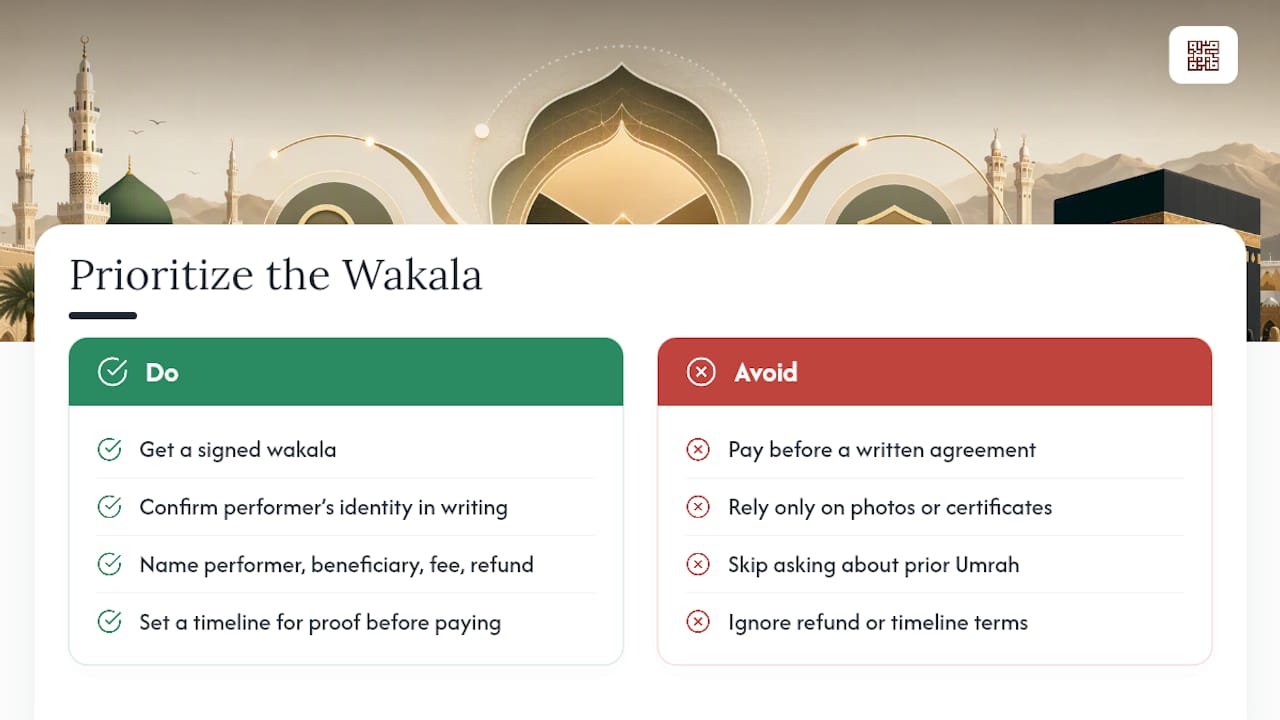
Families rarely get scammed because a provider misunderstood Islamic law. They get scammed because nobody asked for a signed wakala, nobody confirmed the performer’s identity, and nobody set a timeline for proof before money changed hands. The performer’s own prior Umrah matters enormously, but so does knowing exactly who that performer is and having it in writing.
If you take one thing from this guide, prioritize the wakala agreement over everything else. A provider willing to put the arrangement in writing, naming the performer, the beneficiary, the fee, and the refund terms, has already cleared the biggest hurdle that separates a legitimate service from a risky one. Everything downstream, the certificate, the photos, the video, only means something if that foundation exists first.
— anas
Ready to Book a Documented Badal Umrah?
If you’ve read this far, you already know what to look for: a named performer with prior Umrah experience, a written agreement, and real proof after the fact. Some providers build their packages around exactly that structure, so you’re not stitching together promises from a phone call, you’re getting a documented process from booking to completion.
The Umrah Badal Barakah Premium Package includes a certificate, full photo set, complete video, and live verification for readers who want to see the Umrah performed in real time. Families working with a tighter budget can look at the Umrah Badal Noor Package, which still includes a certificate, photos, and video, or the du’a-focused package for a simpler option. Compare tiers directly on the Umrah Packages page, and check the FAQ for refund policy and process details before you commit. Families arranging Badal Umrah alongside other end-of-life planning may also find funeral pre-arrangement guidance useful for coordinating timing. Reach out through providers’ sites to confirm your beneficiary’s details and start your booking.
Where to Verify These Rules Yourself
For readers who want to check the religious and procedural details independently, a few sources are worth bookmarking. Badalumrah’s own step-by-step guide to the Badal process walks through the rituals and niyyah timing in detail, while the Islamic rulings page lays out the scholarly basis. External guides worth reading include KSA Travels’ overview of Umrah Badal and Tarteel Travel’s breakdown of common mistakes that can invalidate a substitute Umrah. Cross-checking a provider’s claims against these sources takes ten minutes and can save you from a costly mistake.
Sources
- Umrah Badal (Proxy Umrah) – How to Perform Umrah on Behalf of Others
- Umrah Badal (Proxy Umrah) | Complete Guide to Performing Umrah on Behalf of Others
- Umrah Badal | Perform Umrah on Behalf of Someone Else
- What Is Badal Umrah? Intention, Requirements, & Procedure
FAQ
Can I Arrange Badal Umrah for Someone Who Is Just Temporarily Sick?
No. Badal Umrah is meant for the deceased and those permanently unable to travel, not for temporary illness or short-term obstacles. If recovery is possible, the obligation stays with that person until they can perform it themselves.
Does the Representative Need to Have Performed Umrah Before?
Yes, this is a firm requirement. The performer must have already completed their own Umrah before they can validly perform one on behalf of someone else.
Can One Representative Perform Umrah for Multiple People at Once?
No. Each Umrah can only be performed for one named person, so a representative handling multiple beneficiaries needs to complete a separate, full Umrah for each one.
What Proof Should a Legitimate Provider Give Me After Completion?
Expect at minimum a signed certificate naming your beneficiary, along with timestamped photos, and ideally video footage. Some providers offer live verification on premium packages for families who want to witness the process directly.
Do I Need Permission From the Person I’m Representing?
If they’re alive, yes, you need their explicit consent before arranging Badal on their behalf. If they’ve passed away, permission from their heirs is the accepted standard.