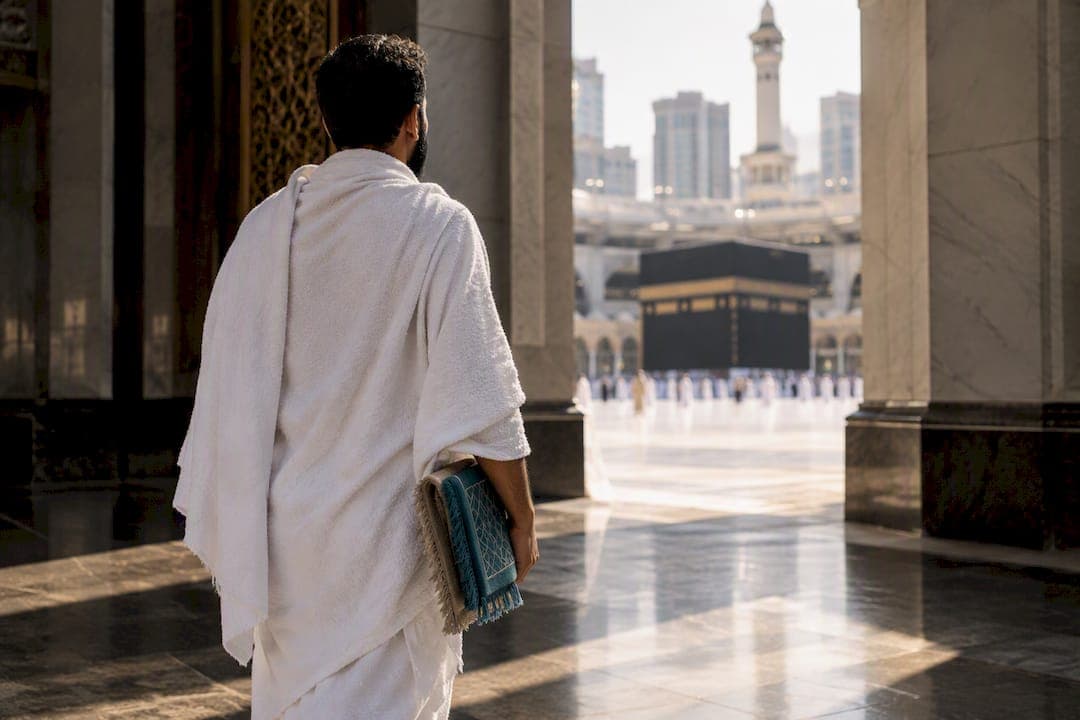
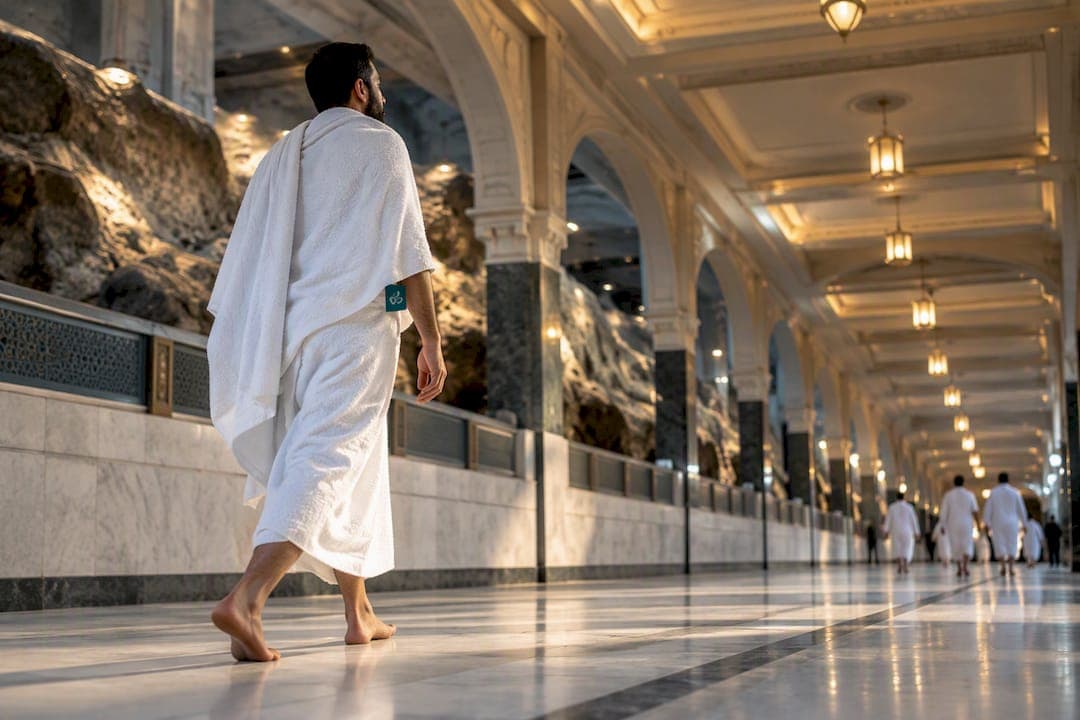
- umrah for deceased mother
- umrah for miscarried baby
- umrah for minor child
- umrah for deceased child
- sponsoring umrah for mother
- performing umrah for mother
- how to perform umrah for deceased
- umrah intention for mother
- umrah for child
- umrah pilgrimage for deceased
Safely Perform Umrah for a Deceased Mother: Niyyah and Vetting Steps
Published on Sep 8, 2026
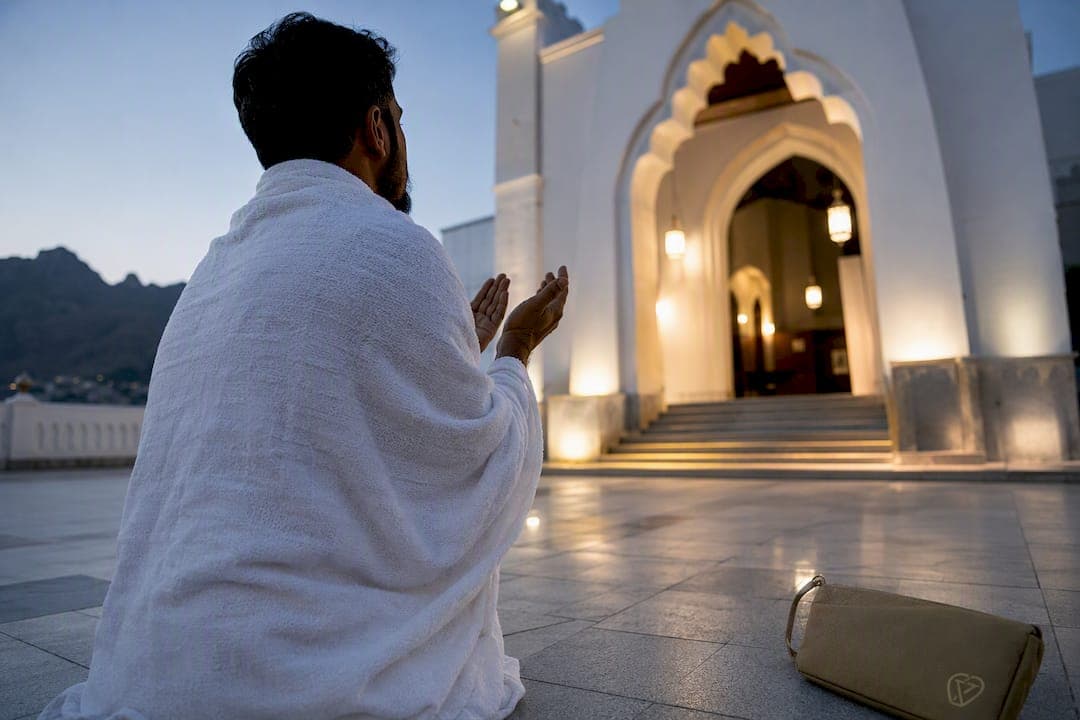
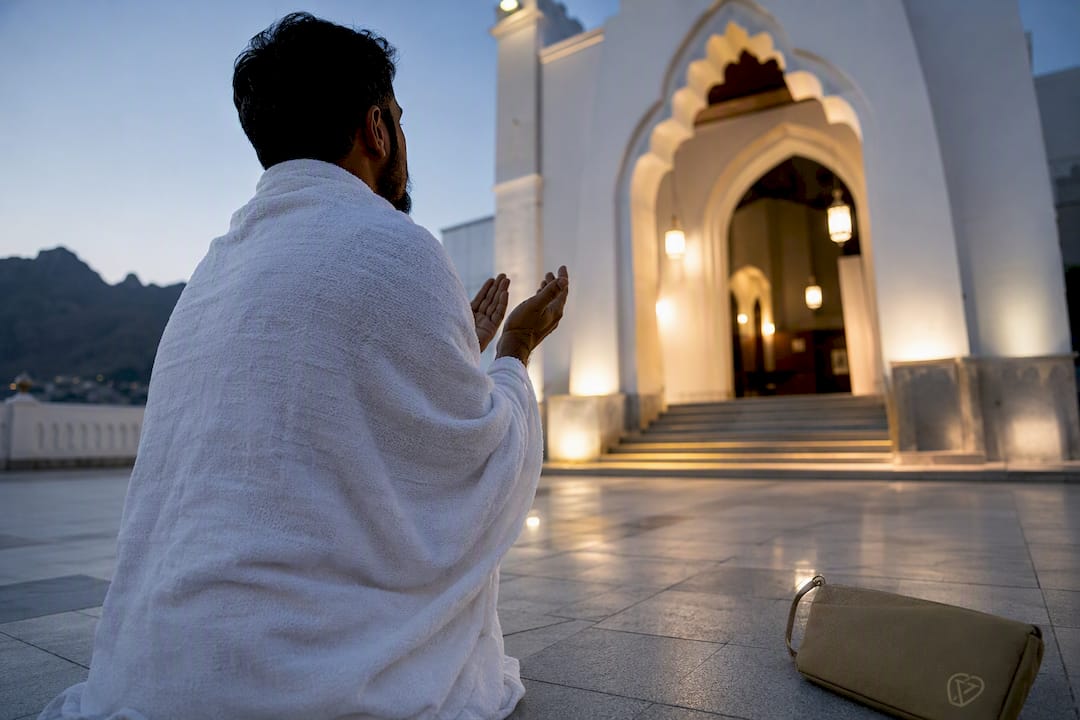
Performing Umrah on behalf of a deceased mother is permissible in the majority scholarly view, and most fatwa bodies rank it among the most rewarding acts a child can offer her. The one requirement that makes or breaks it is the niyyah, the explicit intention you set at Ihram naming her as the beneficiary. Practically, your next move is simple: if you haven’t completed your own Umrah, do that first, then either perform Badal Umrah yourself or book a vetted representative.
TL;DR:
- Always perform your own Umrah first if you haven’t already before doing one on behalf of a deceased mother to ensure validity.
- Set a clear intention at Ihram explicitly naming her as the beneficiary, as this is the key act that grants reward to the deceased.
- Each additional Umrah for the same or different deceased requires a fresh Ihram, renewal at Tan’eem, and a separate niyyah.
- Reputable providers must give proof of the rites performed, with documented confirmation that they are not subcontracted, to avoid unreliable intermediaries.
- Pairing the Umrah with ongoing du’as and charity acts can amplify the benefit for the deceased beyond the ritual itself.
Table of Contents
- Scholarly Rulings on Umrah for a Deceased Mother
- How to Perform Umrah on Behalf of a Deceased Mother
- Ihram, Tan’eem, and the Multiple-Beneficiary Question
- Hiring a Representative Versus Doing It Yourself
- Du’as, Intentions, and Deeds That Continue Helping Her
- Cultural Practices Around Umrah for a Deceased Mother
- What Badal Umrah Offers Families Arranging This
- A Personal Note on Praying for a Mother From Afar
- Sources
Scholarly Rulings on Umrah for a Deceased Mother
Fatwa bodies including IslamWeb hold that performing Hajj or Umrah on behalf of a deceased parent is not just allowed but desirable, and the reward reaches her directly. The ruling traces back to hadith precedent where the Prophet permitted Hajj on behalf of someone unable to perform it, a basis modern scholars extend to Umrah Badal under similar conditions.
The four major schools largely agree on the core permissibility, though they differ on finer points like whether the deputy must have already performed their own Umrah, and how strictly repeat Umrahs must be separated by person. Where scholars diverge, the practical guidance converges: don’t let minor fiqh disagreement stop you from acting.
Eligibility extends to:
- The deceased, regardless of whether they performed Umrah in their lifetime
- The chronically ill or physically incapacitated who cannot travel
- Living relatives who explicitly grant permission for someone to gift them the reward, a separate category from Badal for the deceased
IslamWeb’s guidance specifically recommends prioritizing the mother when a person has the means to perform Badal Umrah for only one parent at a time, citing her elevated status in multiple hadith. If you’re choosing between parents and resources are limited, start with her.
How to Perform Umrah on Behalf of a Deceased Mother
Follow this sequence whether you’re doing it yourself in Makkah or briefing a representative:
-
Complete your own Umrah first. Common scholarly guidance, echoed in practical explainers like Amaliah’s coverage of Umrah for the deceased, holds that you should perform your own Umrah before doing one on behalf of another person, if you haven’t already.
-
Set the niyyah at Ihram. This is the pivot point of the entire act. At the point of entering Ihram, form the intention in your heart, and you may say something like: “I intend to perform Umrah on behalf of my mother [her full name], and I make myself Muhrim for that purpose.” Arabic speakers commonly say a version of “Allahumma inn Urdu al-'Umrata 'an ummi [name], fa Assyria li wa taqabbalha Mina.” The wording doesn’t need to be exact. Sincerity and clarity of intention matter more than a fixed formula.
-
Perform tawaf. Seven circuits around the Kaaba, exactly as you would for your own Umrah.
-
Perform sa’i. Seven passes between Safaa and Marwah, same physical process as a personal Umrah.
-
Complete tahleel. Shave the head (for men) or trim a portion of hair (for women) to close the rites.
-
If performing Umrah for multiple deceased people, exit the Haram boundary, then renew Ihram at Tan’eem before starting the next Umrah. Each additional Umrah for a different person needs its own fresh Ihram and niyyah.
-
Keep a simple record. Note the full name of the deceased, her relationship to you, the date each Umrah was completed, and whatever documentation (photos, receipts, certificates) you’ll want later.
You don’t need to repeat the intention during tawaf or sa’i. Practical pilgrim resources like The Pilgrim’s guide to performing Umrah for someone else confirm the intention made at Ihram carries through the entire rite.
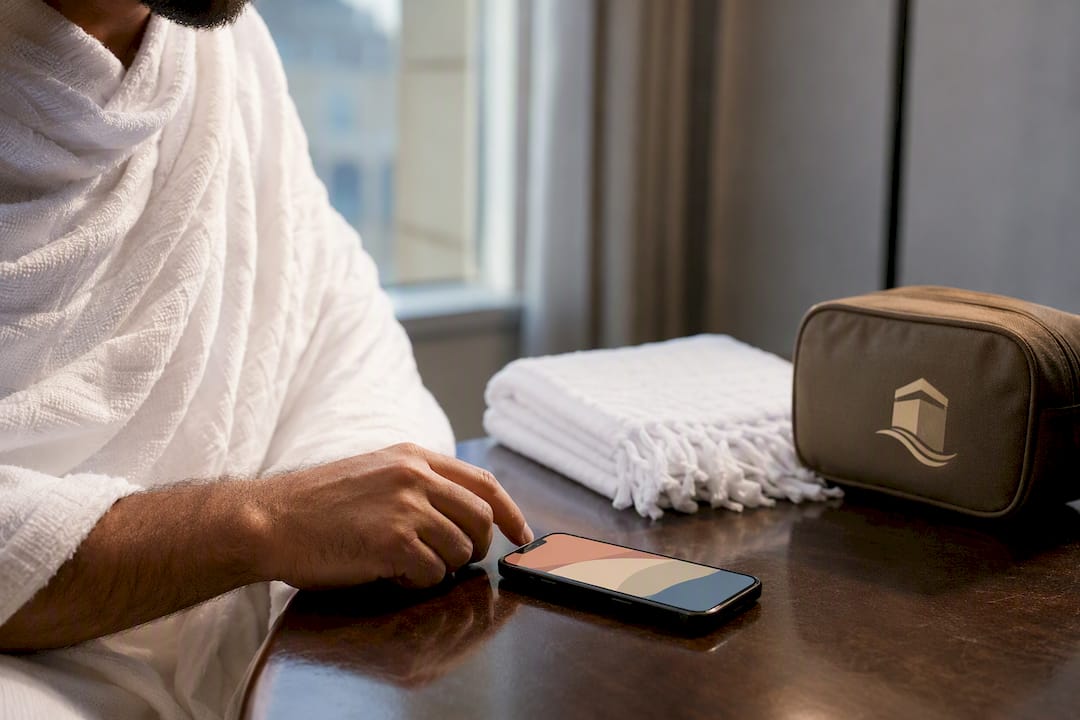
Pro Tip: Write your mother’s full name and the exact date on your phone before you enter Ihram. In the emotion of the moment, at the Kaaba, thinking of her, it’s easy to forget small details you’ll want later for your own records or for family who ask.
Ihram, Tan’eem, and the Multiple-Beneficiary Question
Renewing Ihram for a repeat Umrah has one accepted location inside Makkah: Tan’eem, home to Masjid Aisha, sits just outside the sacred boundary and functions as the standard re-entry point. Fiqh guidance on the technical process of performing Umrah for the deceased confirms this is where pilgrims typically go to assume Ihram again before a second or third Badal Umrah.
A question that comes up constantly: can one Umrah cover two deceased parents at once? A Hanafi-focused analysis from SeekersGuidance addresses this directly. While some opinions allow flexibility, the more conservative and widely recommended approach is a separate, individual Umrah for each deceased person. If you’re arranging Umrah for both your mother and father, plan for two distinct rites, not one combined intention.
A few technical notes worth flagging:
- Intention set at Ihram typically suffices for the whole rite; you don’t need to mentally renew it during tawaf or sa’i.
- Gender and mahram requirements for the living performer follow the same rules as any personal Umrah, meaning a woman generally still needs an eligible male companion for travel per her own circumstances.
- Travel logistics (visa, transportation to Tan’eem for repeat Ihram) fall on whoever is physically performing the rite, whether that’s you or a representative acting for your family.
Hiring a Representative Versus Doing It Yourself
If distance, health, or logistics keep you from traveling, delegation is religiously valid, but the standards are strict. IslamQA’s guidance on delegating Umrah for the deceased is clear that the deputy must be trustworthy and must personally perform the rites, not simply collect payment and disappear.
Ibn Uthaymin’s guidance, referenced in that same IslamQA discussion, warns specifically against intermediaries who accept a fee and then quietly re-delegate the pilgrimage to someone else without telling the paying family. That practice undermines the integrity of the whole arrangement, since you no longer know who is actually standing at the Kaaba on your mother’s behalf.
Red flags worth watching for:
- Vague or generic proof that could belong to anyone, rather than dated, named documentation
- Prices dramatically lower than the market average with no explanation
- Reluctance to confirm, in writing, that your Umrah won’t be re-delegated to a third party
Before paying anyone, ask for proof of completion (photos, video, a certificate naming the deceased), a direct confirmation that the person performing the rite won’t subcontract it out, transparent pricing with no hidden fees, and, ideally, references from past clients. Reputable providers build their entire reputation on this kind of documentation being available and specific, not generic stock imagery reused across bookings.
Du’as, Intentions, and Deeds That Continue Helping Her
Your niyyah at Ihram is the legal anchor of the act, but the du’as you make during tawaf and after sa’i carry real weight too. Ask specifically for her forgiveness, for her elevation in status, and for ease in whatever stage of the afterlife she’s in. There’s no required formula.
Scholars quoted in Amaliah’s piece on Umrah for the deceased stress that a sincere du’a from a righteous child carries particular weight for a parent. Pair the Umrah with acts that keep giving after you’ve left Makkah:
- Ongoing charity (sadaqah jariyah) given explicitly in her name
- Regular Quran recitation dedicated to her
- Recurring donations to causes she cared about during her life
None of this replaces the Umrah itself. It compounds it.
Cultural Practices Around Umrah for a Deceased Mother
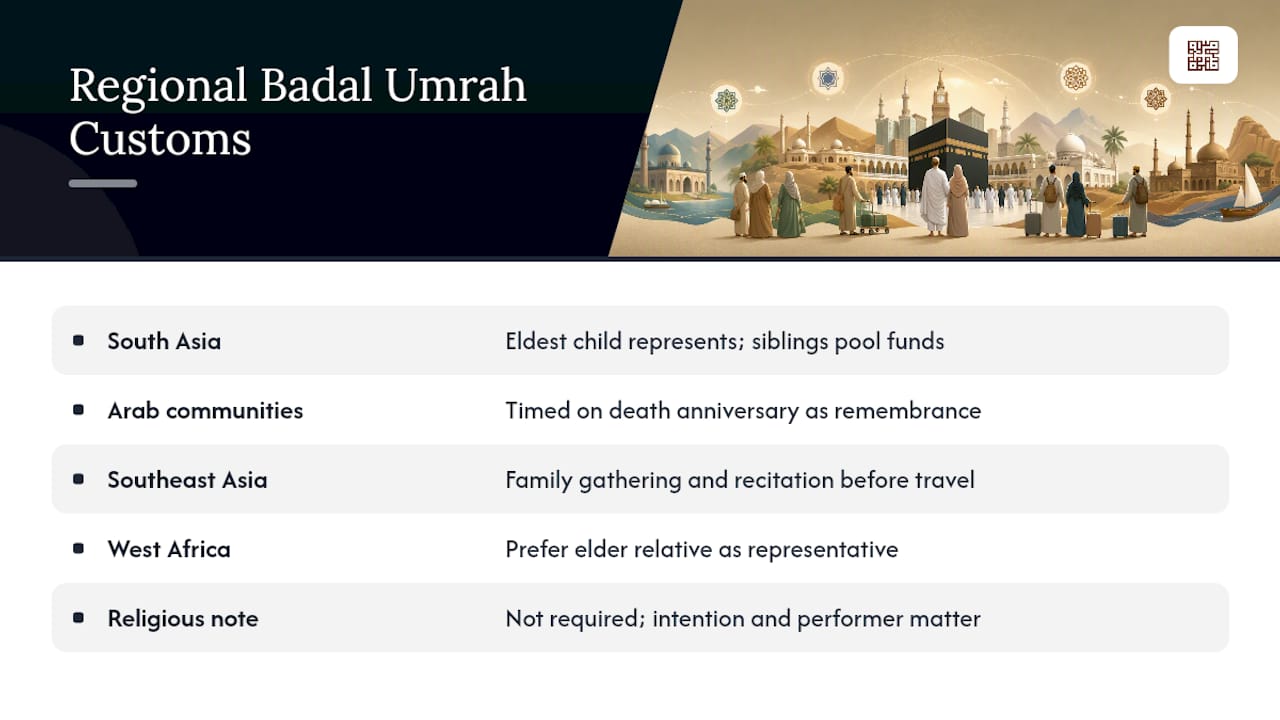
Families across different regions handle Badal Umrah for a mother with their own local customs layered on top of the core ritual. In parts of South Asia, it’s common for the eldest child, often a son, to be designated as the family’s representative for Badal Umrah, with siblings pooling funds to cover the cost as a shared act of filial duty. In many Arab communities, families sometimes time the Badal Umrah to coincide with the anniversary of the mother’s passing, treating it as an annual act of remembrance rather than a one-time obligation.
Southeast Asian Muslim communities, particularly in Indonesia and Malaysia, frequently combine the Umrah with a formal family gathering or recitation event before departure, turning the booking process itself into a small communal ritual. Some families in West Africa prioritize sending an elder relative rather than hiring an unrelated representative, valuing personal connection to the deceased over convenience or cost.
None of these customs are religious requirements. They’re cultural layers that families add around a core act whose validity depends only on correct intention and a trustworthy performer. If your family doesn’t follow any particular tradition around it, that changes nothing about whether the Umrah counts. What matters is the niyyah, the sincerity, and confirming the person performing the rite is who they claim to be.
What Badal Umrah Offers Families Arranging This
Booking a representative shouldn’t feel like a leap of faith. Some Umrah providers structure their packages around common concerns such as proof of non-delegation, documented evidence, and transparent pricing set before payment.
Packages range from documented options like the Umrah Badal Noor Package, which includes a certificate, photos, and video, up to the Umrah Badal Barakah Premium Package, which adds full video and a live option so you can watch key moments of the rite as they happen. Every booking is built around the same eligibility and delegation standards outlined in the fatwas above: performed by a real, named individual, with proof you can actually verify, not a stock photo recycled across a hundred orders.
The booking process itself is straightforward. You select a package from the full Umrah Packages collection, submit your mother’s name and details, and receive documentation once the Umrah is complete. Customer support stays available throughout for questions about timing or proof. Badalumrah also directs a portion of profits toward charitable relief for Gaza, so your booking carries a second layer of ongoing benefit beyond the Umrah itself. If you’re ready to move forward, review the FAQ page for specifics on documentation and timelines, then choose a package that fits your budget.
A Personal Note on Praying for a Mother From Afar
There’s something specific about standing in for a parent who can no longer stand for herself. The intention you form at Ihram becomes the one thing that matters most, more than the words, more than the logistics.
If you’re arranging this for your mother, don’t skip the vetting steps: ask for proof, confirm the person performing it won’t quietly hand the job to someone else, and get documentation in writing. Then pair it with something that keeps giving, a standing charity in her name, regular Quran recitation, anything that outlives the single trip to Makkah.
— anas
Sources
- Perform Hajj and ‘Umrah on behalf of your mother first — IslamWeb
- Can You Delegate Someone to Perform `Umrah on Behalf of a Dead Person? — IslamQA
- Can one Umra be performed on behalf of two deceased? — SeekersGuidance
- Fiqh