- umrah proxy from abroad
Umrah by Proxy From Abroad: How to Arrange It Properly
Published on Nov 11, 2026
Umrah by Proxy From Abroad: How to Arrange It Properly

You can arrange Umrah by proxy from anywhere in the world. The person it is performed for must be permanently unable to travel, or must have passed away. The proxy must have already performed their own Umrah. The proxy forms the intention for the named person and completes every rite in Makkah. You then receive proof of completion. This guide explains each step for families in the United States and elsewhere, in plain words.
TL;DR
- Umrah by proxy (badal) is for someone who is permanently unable to perform Umrah, for example through old age or an incurable illness, or for someone who has died.
- A living person must give clear permission. The proxy must already have performed their own obligatory Umrah.
- The whole process can be arranged online from abroad: you choose a package, give the name, pay once and follow the update.
- Each Umrah is intended for one named person, so families usually book one Umrah per person.
- Our packages run from $150 to $500 for Umrah, each with a one-time fee and proof of completion.
Table of Contents
- What Umrah by proxy means
- Who can have Umrah performed for them
- Who may act as the proxy
- How the proxy makes the intention
- One Umrah, one person
- How to arrange it from abroad, step by step
- What proof to expect
- Our packages and prices
- Book your Umrah by proxy
- Our perspective
- Questions families ask
- Sources
What Umrah by proxy means
Umrah by proxy means appointing a trusted person to perform Umrah in Makkah for someone who cannot do it. Scholars call this al-inabah. The Jordanian Iftaa’ Department describes it as appointing a representative for a person unable to perform it because of incurable illness or old age.
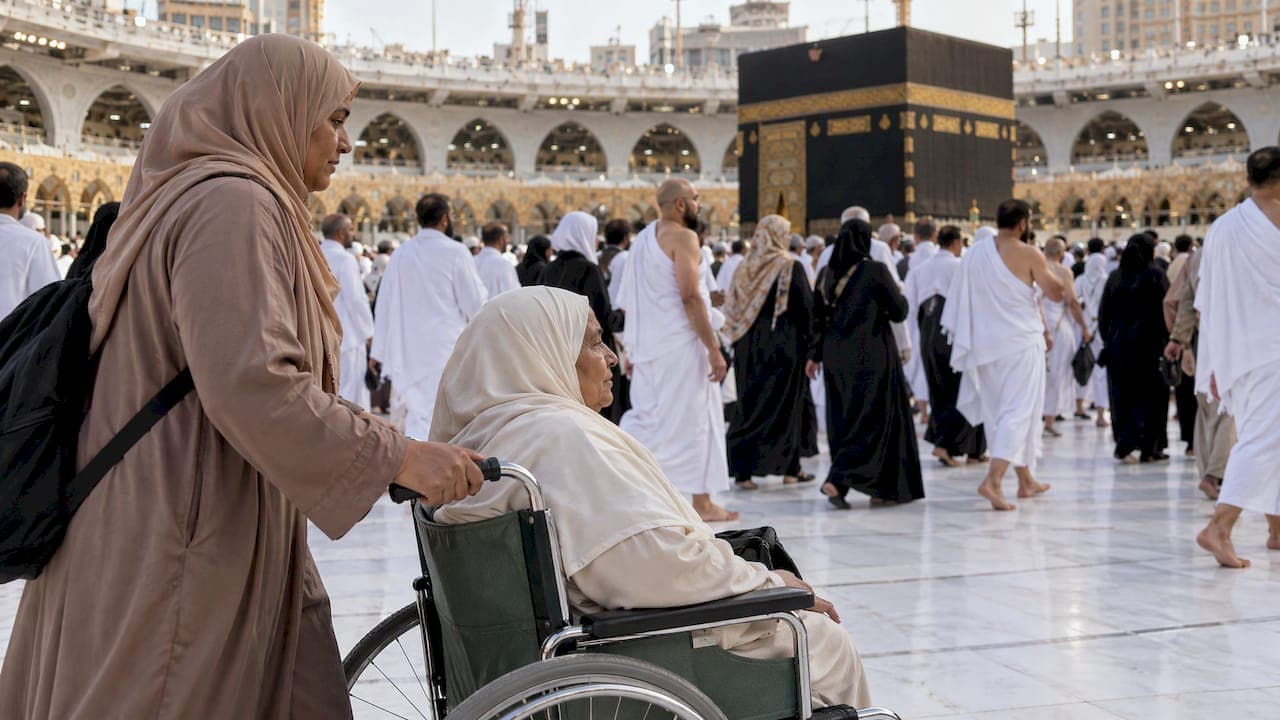
The proxy does not do a symbolic act. They enter ihram at the miqat, perform tawaf around the Ka’bah, pray two rak’ahs, walk the sa’i between Safa and Marwa, and finish by cutting or shortening the hair. The rites are the same as for their own Umrah. The only difference is the intention: it is made for someone else.

This is why people living far from Makkah turn to it. A son in Houston, a daughter in Toronto or a family in London cannot always travel, and often the person they love cannot either. A proxy lets the family fulfil that wish in a way that follows the rulings of Islamic law.
Who can have Umrah performed for them
There are two main situations.
A living person who is permanently unable
The condition is that the person cannot perform Umrah themselves and does not expect to recover. The Iftaa’ Department lists old age, chronic illness, or a disability with no expected recovery as qualifying cases. A temporary illness that is expected to pass does not fit this description. In that case, many families choose to wait and let the person travel when they are well.
The living person keeps their free will, so they must give their permission. According to the same Iftaa’ Department ruling, explicit authorization is required when the represented person is alive. Ask them directly, and keep a record of their consent in a message or a note. If your relative is terminally ill, our guide on arranging a verified Umrah for a terminally ill person walks through the steps. For other living relatives, read about documented proxy Umrah for permanently unable relatives.

A person who has died
Many families want to perform Umrah for a parent, spouse or grandparent who passed away without having done it. Scholars generally allow this as an act of devotion for the deceased. Our page on Umrah for deceased parents covers the rulings families ask about most, and the page on Umrah for a spouse does the same for husbands and wives.
The schools of thought differ in detail, and some scholars prefer that people gift the reward of their own deeds instead. If your family follows a particular school, speak with your imam or a scholar you trust before booking. That is good practice, and it gives you peace of mind.
Who may act as the proxy
The proxy matters as much as the package. These are the conditions scholars set.
- They have performed their own Umrah first. All four Sunni schools require this before acting for another person. Islamweb adds that where Umrah is obligatory upon the relative, a deputy may perform it only if the relative has a chronic, incurable illness and the deputy has already completed their own.
- They are a Muslim adult of sound mind. Our guide on why a minor should not be the proxy gives a checklist families can use.
- They are trustworthy and know the rites. Scholars such as Shaykh Ibn 'Uthaymin stressed knowledge and honesty, so the Umrah is not treated as a routine task.
- They know whom the Umrah is for. The intention is made for one named person.
Questions about women acting as proxies come up often. We explain them in the rules for a female Umrah proxy and in the gender rules for badal Umrah.
How the proxy makes the intention
The proxy puts the intention in their heart for the person they represent when they enter ihram. It is preferred to say it aloud, using words such as Labbayk Allahumma 'an followed by the name. The Standing Committee fatwa recorded on Islamhelpline says that naming the person is not essential and that the intention in the heart is enough, though saying the name at the start of the talbiyah is preferable.
The Umrah is then completed like any other. The represented person receives the reward of the Umrah, and the proxy is rewarded for their service. Because of this, a family should give the full name of the person (and a mother’s name if the provider asks for it) so the intention is clear.
One Umrah, one person
Families often ask whether one Umrah can cover several relatives. Scholars have given different answers, and it helps to know this before you book.
- Shaykh Ibn Baz held that Umrah is performed for one person at a time.
- Shaykh Ibn Fawzan said that one Umrah is for one person. He gave the example of performing it for one parent, then again for the other.
- Other scholars permit more than one person if the conditions are met, including the consent of a living person. SeekersGuidance records this view, and the office of Grand Ayatollah al-Hakeem says a recommended Umrah may be for more than one person.
The simplest path for most families is one Umrah for each loved one, each with its own intention and its own proof. Our page on multiple proxy Umrahs explains how to arrange this for a parent, a spouse and others.
How to arrange it from abroad, step by step
Distance is no obstacle. This is how a booking works with us.
- Decide who the Umrah is for. Write down the full name. If the person is alive, confirm they agree and are permanently unable to travel.
- Choose a package. Packages differ in speed and in features. Pick the one that fits your family and your timing.
- Book online and pay once. We charge a one-time fee with a fixed price. There are no recurring charges.
- Follow the update. We keep you informed as the Umrah is carried out.
- Receive your proof. After completion you receive documentation, which can include photos, video and a certificate, depending on the package.
- Make du’a. Many families gather, recite and pray for their loved one on the day it is done.
There is no passport, visa or flight for you to arrange. That matters a great deal for an elderly parent in a nursing home, or a family spread across several time zones.
What proof to expect
A family is entitled to know that the Umrah was done. We provide proof of completion with every booking: photos, videos and a certificate, with dedicated support if you have questions. Our article on the four proofs of Umrah completion explains what each document shows and how to read it.
We also publish how our service meets the rulings, in our guide to Shariah compliance, Saudi fatwas and eligibility. Our work is verified by qualified imams, and we share updates so that nothing is hidden.
Our packages and prices
| Package | Price (one-time) |
|---|---|
| Du’a Package | $150 |
| Noor Package | $250 |
| Barakah Package | $400 |
| Jariyah Premium Package | $500 |
| Hajj Badal, Ifraad | $1,500 |
| Hajj Badal, Tamattu’ (with Umrah and Qurbani) | $2,500 |
The first four are Umrah packages, from the Du’a Package at $150 to the Jariyah Premium Package at $500. The two Hajj options are for families who want Hajj performed on behalf of someone. Prices are as published on our site, so check the package page before you pay.
Book your Umrah by proxy
If you know whom the Umrah is for, you are ready to book. Choose the package that suits your family and enter the name. We take care of the rest, and you stay informed until the proof reaches you.
Start on our booking page, or look at the Du’a Package at $150 if you want to begin with our core Umrah service.
Our perspective
Many families come to us after a long silence. A father passed away before he could make the journey. A mother is too frail to leave her bed. The wish to do something is strong, and the distance feels heavy.
We believe the answer to that wish should be sincere, careful and open. That means a proxy who has performed their own Umrah, an intention made for your loved one by name, and a record you can keep. It also means a fixed price, so the fee is clear before you pay.
Some scholars say worship is best done by the person themselves. We agree, and that is why we ask families to book only where the person is permanently unable or has passed away. When that is the case, a proxy Umrah is a real act of love and duty, not a shortcut. We take that trust seriously, and a portion of our profits goes to charity, including support for Gaza.
For you. For your loved ones. For their forgiveness.
anas
Questions families ask
Can I arrange Umrah by proxy if I live in the United States?
Yes. Everything is done online, and the Umrah is performed in Makkah by the proxy. You give the name, pay once and receive the proof. You do not need to travel or obtain a visa.
Can I send a proxy for a relative who is only temporarily ill?
Scholars link proxy Umrah for a living person to a permanent inability, such as old age or an illness with no expected recovery. If the illness is temporary, the usual advice is to wait until the person can travel. If you are unsure, ask your imam. Our guide on Umrah for a living person explains the details.
Does the proxy need to say the name aloud?
No. The intention in the heart is enough, although saying the name at the start of the talbiyah is preferred, according to the fatwa recorded on Islamhelpline. We ask for the full name so the intention is clear.
Does the proxy have to tell the person first?
If the person is alive, their permission is required. If someone is given the task and wants to pass it to another, IslamQA advises that they perform it themselves or inform the appointor first, since that person may not agree.
Is a proxy Umrah accepted by every scholar?
Not every school gives the same weight to it. Some scholars discourage delegating a voluntary Umrah, and Shaykh Ibn 'Uthaymin preferred that worship be done by the person where possible. Where a person is permanently unable or has died, many scholars allow it. Speak with a scholar from your own school if you want to be sure.
Sources
- Iftaa’ Department of Jordan: delegating someone to perform Umrah
- SeekersGuidance: rulings on performing Hajj and Umrah on behalf of another
- Islamweb: conditions for performing Umrah on behalf of a relative
- Islamhelpline: naming the person on whose behalf Umrah is performed
- Al-Fatawa: one Umrah on behalf of several individuals
- Al-Fatawa: Umrah on behalf of both parents at the same time
- Office of Grand Ayatollah al-Hakeem: Umrah for more than one person
- IslamQA: delegating someone to perform Umrah on behalf of another
- IslamQA: Umrah on behalf of someone alive